

Published
3/4 inch is bigger than 5/8 inch. 3/4 is 0.750 inch and 5/8 is 0.625 inch, so 3/4 is larger by exactly 1/8 inch — 0.125 inch, or 3.175 mm. In percentage terms, 3/4 is 20% larger than 5/8.
The reason 5/8 looks like it should be the bigger of the two is that 5 is bigger than 3. It is not, because the two fractions are counting different-sized pieces: eighths of an inch against quarters of an inch. Put both over the same denominator and the comparison becomes obvious — 5/8 against 6/8.
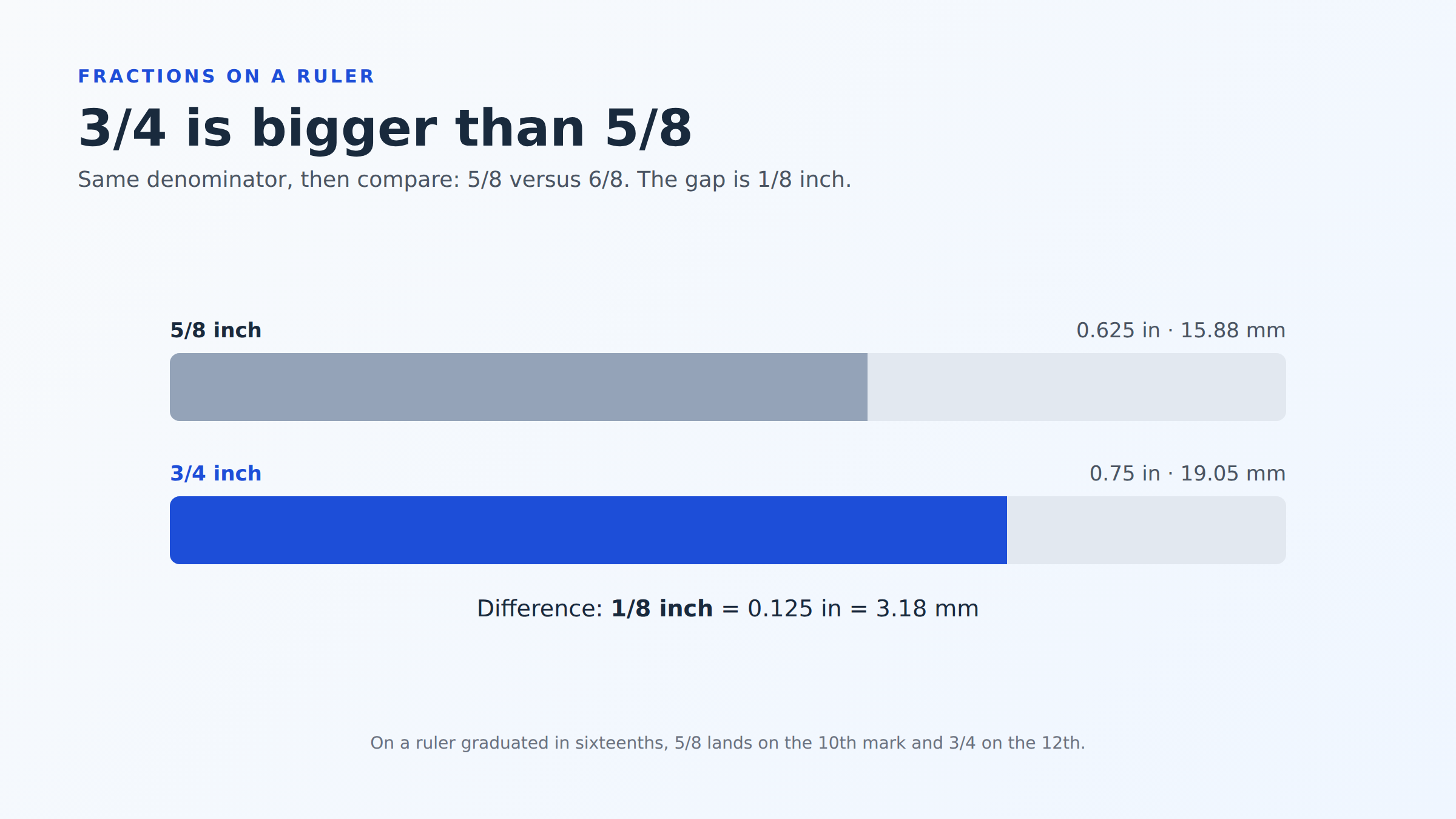
5/8 vs 3/4 inch, side by side
| 5/8 inch | 3/4 inch | Difference | |
|---|---|---|---|
| Decimal | 0.625 in | 0.750 in | 0.125 in |
| Millimetres | 15.875 mm | 19.05 mm | 3.175 mm |
| In eighths | 5/8 | 6/8 | 1/8 |
| In sixteenths | 10/16 | 12/16 | 2/16 |
| As a percentage | 83.3% of 3/4 | 120% of 5/8 | 3/4 is 20% larger |
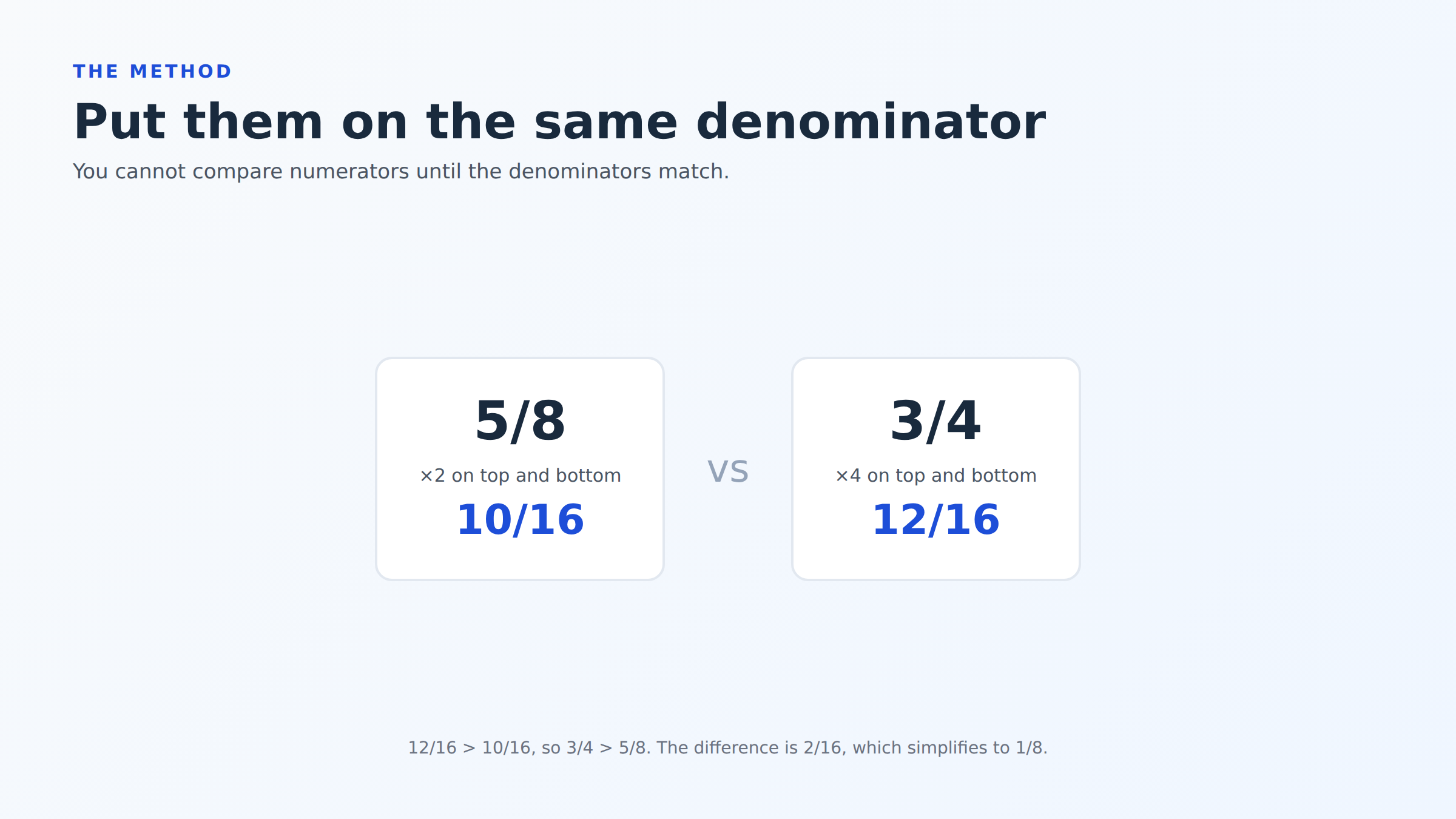
Every row says the same thing in a different unit. The one worth remembering is the sixteenths row: 5/8 is ten sixteenths and 3/4 is twelve, so the gap is two sixteenths — one eighth of an inch, two of the smallest marks on an ordinary tape measure.
Inch fraction chart: sixteenths, decimals and millimetres
Every fraction that appears on a standard imperial tape measure, in order:
| Fraction | In sixteenths | Decimal inches | Millimetres | Relative length |
|---|---|---|---|---|
| 1/16 in | 1/16 | 0.0625 in | 1.5875 mm | █ |
| 1/8 in | 2/16 | 0.1250 in | 3.1750 mm | ██ |
| 3/16 in | 3/16 | 0.1875 in | 4.7625 mm | ███ |
| 1/4 in | 4/16 | 0.2500 in | 6.3500 mm | ████ |
| 5/16 in | 5/16 | 0.3125 in | 7.9375 mm | █████ |
| 3/8 in | 6/16 | 0.3750 in | 9.5250 mm | ██████ |
| 7/16 in | 7/16 | 0.4375 in | 11.1125 mm | ███████ |
| 1/2 in | 8/16 | 0.5000 in | 12.7000 mm | ████████ |
| 9/16 in | 9/16 | 0.5625 in | 14.2875 mm | █████████ |
| 5/8 in | 10/16 | 0.6250 in | 15.8750 mm | ██████████ |
| 11/16 in | 11/16 | 0.6875 in | 17.4625 mm | ███████████ |
| 3/4 in | 12/16 | 0.7500 in | 19.0500 mm | ████████████ |
| 13/16 in | 13/16 | 0.8125 in | 20.6375 mm | █████████████ |
| 7/8 in | 14/16 | 0.8750 in | 22.2250 mm | ██████████████ |
| 15/16 in | 15/16 | 0.9375 in | 23.8125 mm | ███████████████ |
| 1 in | 16/16 | 1.0000 in | 25.4000 mm | ████████████████ |
Reading down the sixteenths column turns any comparison into counting. A fraction with more sixteenths is bigger; there is nothing else to check. Note also that the millimetre column never produces a round number: one sixteenth of an inch is 1.5875 mm, so inch fractions and millimetres only coincide at zero.
How to compare two fractions without calculating
Method 1 — put them over the same denominator
When one denominator divides evenly into the other, rewrite the coarser fraction in the finer unit. Here 4 divides into 8, so the quarters become eighths — multiply the top and the bottom of 3/4 by 2:
- 3/4 = (3 × 2) / (4 × 2) = 6/8
- 5/8 stays as 5/8
- 6 eighths beats 5 eighths, so 3/4 is bigger.
Multiplying the top and bottom by the same number does not change the value of a fraction; it only changes how finely it is sliced. 6/8 is the same length as 3/4, written in a unit that can be compared directly with 5/8.
Method 2 — convert everything to sixteenths
This is the version that works on a tape measure, because every mark on the tape is a number of sixteenths. Multiply the fraction by 16:
- 5/8 × 16 = 10 sixteenths
- 3/4 × 16 = 12 sixteenths
- 12 > 10, so 3/4 is bigger, by 2 sixteenths.
The advantage over method 1 is that it needs no judgement about which denominator to use. Halves, quarters, eighths and sixteenths all convert cleanly, so any two marks on a tape can be compared the same way.
Method 3 — cross-multiply
For fractions where neither denominator divides the other, multiply each top number by the other bottom number and compare the two results:
- 5/8 vs 3/4 → 5 × 4 = 20, and 3 × 8 = 24
- 24 belongs to 3/4, and 24 > 20, so 3/4 is bigger.
Keep the pairing straight: the product of a numerator and the other fraction’s denominator carries the name of the fraction whose numerator was used. Cross-multiplying works for any pair — 7/16 against 5/12, say — where a common denominator is not obvious.
Turning a fraction into a decimal, and back
A fraction becomes a decimal by dividing the top by the bottom: 5 ÷ 8 = 0.625, and 3 ÷ 4 = 0.75. Going the other way, multiply the decimal by 16 and round to the nearest whole number to get the nearest sixteenth:
- 0.625 × 16 = 10 exactly → 10/16 = 5/8
- 0.750 × 16 = 12 exactly → 12/16 = 3/4
- 0.700 × 16 = 11.2 → nearest is 11 → 11/16, which is 0.6875 in, 0.0125 in (0.3175 mm) short of 0.7
The third line is the general case: most decimals do not land on a tape measure mark. Rounding to the nearest sixteenth is never wrong by more than 1/32 inch — 0.03125 in, or 0.79375 mm — and that figure is the limit of what an ordinary imperial tape can resolve.
How to read 5/8 and 3/4 on a tape measure
Imperial tape measures mark fractions by tick length, not by number. The hierarchy is always the same, and learning it removes the need to count:
| Tick | Length | What it marks | How many per inch |
|---|---|---|---|
| Longest, numbered | Full height | The inch | 1 |
| Second longest | About ¾ height | 1/2 inch | 1 |
| Third | About ½ height | 1/4 and 3/4 inch | 2 |
| Fourth | About ⅓ height | 1/8, 3/8, 5/8, 7/8 | 4 |
| Shortest | About ¼ height | The sixteenths | 8 |
So the two fractions in question sit on different kinds of tick, which is the fastest way to tell them apart by eye:
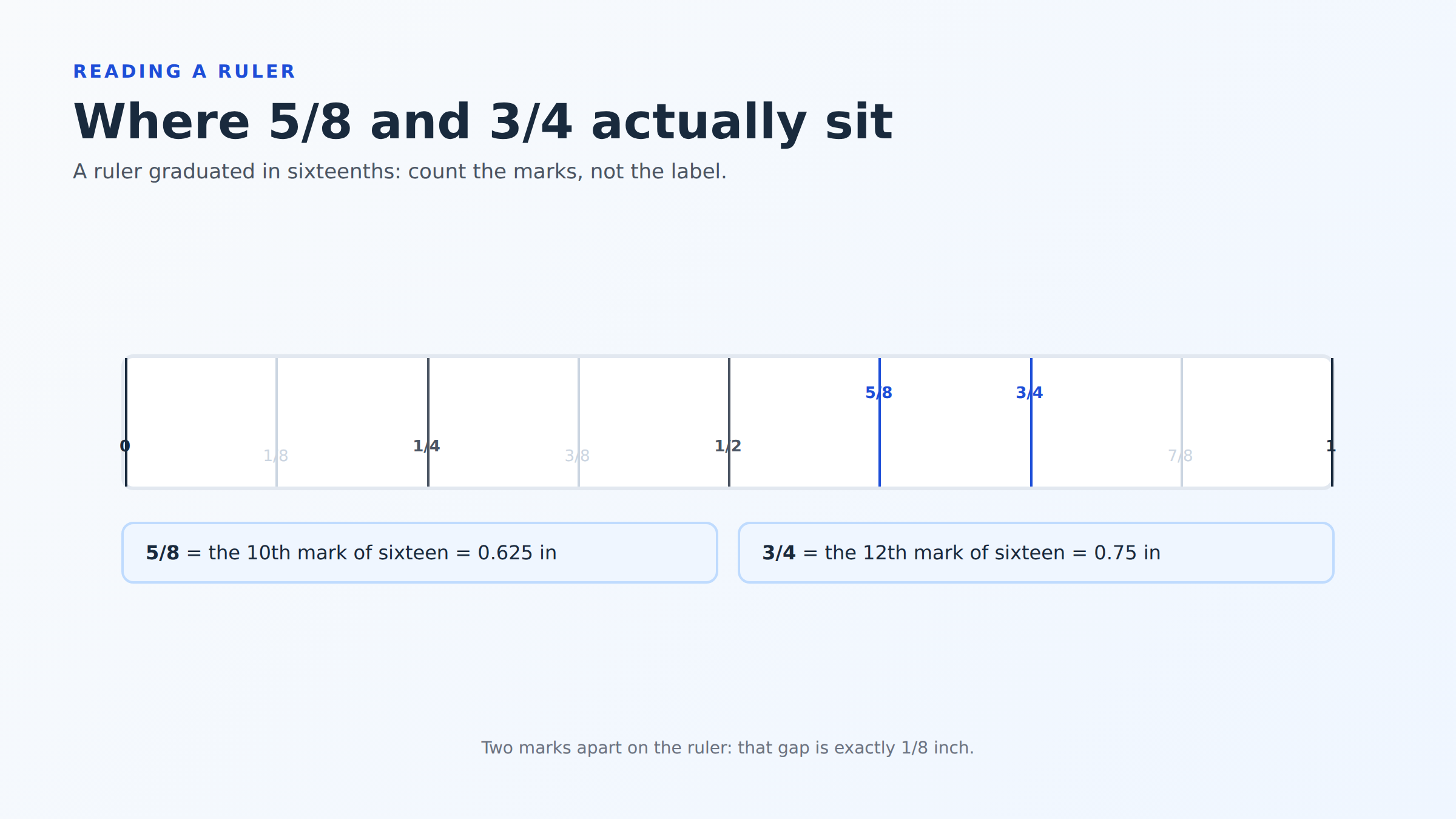
- 3/4 inch is a third-length tick, halfway between the 1/2 mark and the next inch line. It is one of the two most prominent marks inside the inch after the halfway point.
- 5/8 inch is a fourth-length tick, one step past the 1/2 mark. It is shorter than the 3/4 tick and sits before it.
- The gap between them is two of the shortest ticks — 2/16, which is 1/8 inch.
Some tapes add a sixth tier for 1/32 inch (0.03125 in, 0.79375 mm). On those, 5/8 is the twentieth mark after the inch line and 3/4 is the twenty-fourth.
The mistake: a bigger top number does not mean a bigger fraction
Two habits from whole numbers cause nearly every error with inch fractions.
Comparing numerators across different denominators
5 is bigger than 3, so 5/8 looks bigger than 3/4. The numerator only counts pieces; it says nothing about how big a piece is. Comparing 5/8 and 3/4 by their numerators is like comparing five slices of a cake cut into eight against three slices of a cake cut into four — the second set of slices is larger, and three of them beat five of the smaller ones.
Assuming a bigger denominator means a bigger fraction
The denominator works backwards: it is the number of pieces the inch has been cut into, so the larger it gets, the smaller each piece. 1/16 in (1.5875 mm) is the smallest mark on a tape, 1/2 in (12.7 mm) one of the largest, and 16 is far bigger than 2. Whenever the numerators match, the fraction with the smaller denominator is the bigger one.
Reading a decimal as a fraction
0.625 is 5/8 and 0.75 is 3/4, but the decimals are also easy to misread against each other, because one has three digits and the other two. Compare 0.625 with 0.750 rather than with 0.75 — padding the shorter decimal with a zero puts both on the same footing and removes the illusion that 625 is bigger than 75.
Pairs that catch people out
| Pair | In sixteenths | Bigger | By |
|---|---|---|---|
| 5/8 vs 3/4 | 10/16 vs 12/16 | 3/4 in | 1/8 in (0.1250 in / 3.1750 mm) |
| 3/8 vs 1/2 | 6/16 vs 8/16 | 1/2 in | 1/8 in (0.1250 in / 3.1750 mm) |
| 5/16 vs 3/8 | 5/16 vs 6/16 | 3/8 in | 1/16 in (0.0625 in / 1.5875 mm) |
| 7/16 vs 1/2 | 7/16 vs 8/16 | 1/2 in | 1/16 in (0.0625 in / 1.5875 mm) |
| 9/16 vs 5/8 | 9/16 vs 10/16 | 5/8 in | 1/16 in (0.0625 in / 1.5875 mm) |
| 11/16 vs 3/4 | 11/16 vs 12/16 | 3/4 in | 1/16 in (0.0625 in / 1.5875 mm) |
| 5/8 vs 11/16 | 10/16 vs 11/16 | 11/16 in | 1/16 in (0.0625 in / 1.5875 mm) |
| 13/16 vs 7/8 | 13/16 vs 14/16 | 7/8 in | 1/16 in (0.0625 in / 1.5875 mm) |
| 3/16 vs 1/4 | 3/16 vs 4/16 | 1/4 in | 1/16 in (0.0625 in / 1.5875 mm) |
The pattern is consistent: once both fractions are written in sixteenths, every one of these answers is read off in a second. Six of the nine pairs differ by a single sixteenth — 1.5875 mm — which is why they are worth checking rather than guessing.
Where an eighth of an inch matters
3.175 mm is small enough to ignore in some contexts and fatal in others. The difference between 5/8 and 3/4 decides whether parts go together at all when a fixed diameter is involved:
- Drilled holes. A 5/8 in hole will not accept a 3/4 in shaft; the shortfall is 3.175 mm all the way round.
- Threaded fasteners and sockets. A 3/4 in socket on a 5/8 in nut turns freely and rounds the corners instead of gripping.
- Tubing and fittings. Nominal sizes of 5/8 and 3/4 are different product lines, not two labels for one size.
- Sheet material. Over a long run, an eighth of an inch per piece accumulates: eight pieces out by 1/8 in each is a full inch of drift.
- Fabric seam allowances. 5/8 in is a common allowance and 3/4 in is another; using the wrong one changes the finished dimension by 1/4 in across a seamed pair of edges.
More comparisons
- Inches to cm converter: any length in inches, with a 1–100 inch chart and fractions
- Cm to inches converter: the same conversion the other way
- How to measure inches without a ruler: nine reference objects with exact dimensions
- Ring size chart in inches and mm: where sixteenths of an inch are too coarse to be useful
FAQs
3/4 inch is bigger. 3/4 is 0.750 in and 5/8 is 0.625 in, a difference of 1/8 inch — 0.125 in, or 3.175 mm.
By 1/8 of an inch, which is 0.125 in or 3.175 mm. Put another way, 3/4 is 20% larger than 5/8, and 5/8 is 83.3% of 3/4.
Yes. 5/8 is 0.625 in and 1/2 is 0.500 in, so 5/8 is larger by 1/8 inch (0.125 in, 3.175 mm). Written over 8, the comparison is 5/8 against 4/8.
Rewrite both over the same denominator and compare the top numbers. For 5/8 and 3/4, multiply 3/4 by 2/2 to get 6/8; 6 is more than 5, so 3/4 wins. On a tape measure, converting both to sixteenths works for every mark: 5/8 is 10/16 and 3/4 is 12/16.
No, the opposite. The bottom number is how many pieces the inch has been cut into, so a bigger bottom number means smaller pieces. 1/16 in is smaller than 1/8 in, which is smaller than 1/4 in.
Between the 1/2 mark and the 3/4 mark, one eighth-inch tick past the halfway point. Counting the smallest marks on a standard tape, 5/8 is the tenth sixteenth after the inch line, and 3/4 is the twelfth.
To take any of these fractions into metric, use the inches to cm converter or the cm to inches converter.