

Published
A4 is 210 × 297 mm, which is 8.27 × 11.69 inches. US Letter is 8.5 × 11 inches, which is 215.9 × 279.4 mm. Letter is 0.232 inch (5.9 mm) wider; A4 is 0.693 inch (17.6 mm) taller. Neither fits inside the other, which is the whole reason cross-border printing goes wrong.
The chart below gives every ISO 216 A size from A0 to A6 plus the four common North American sizes, in millimetres, centimetres and inches.
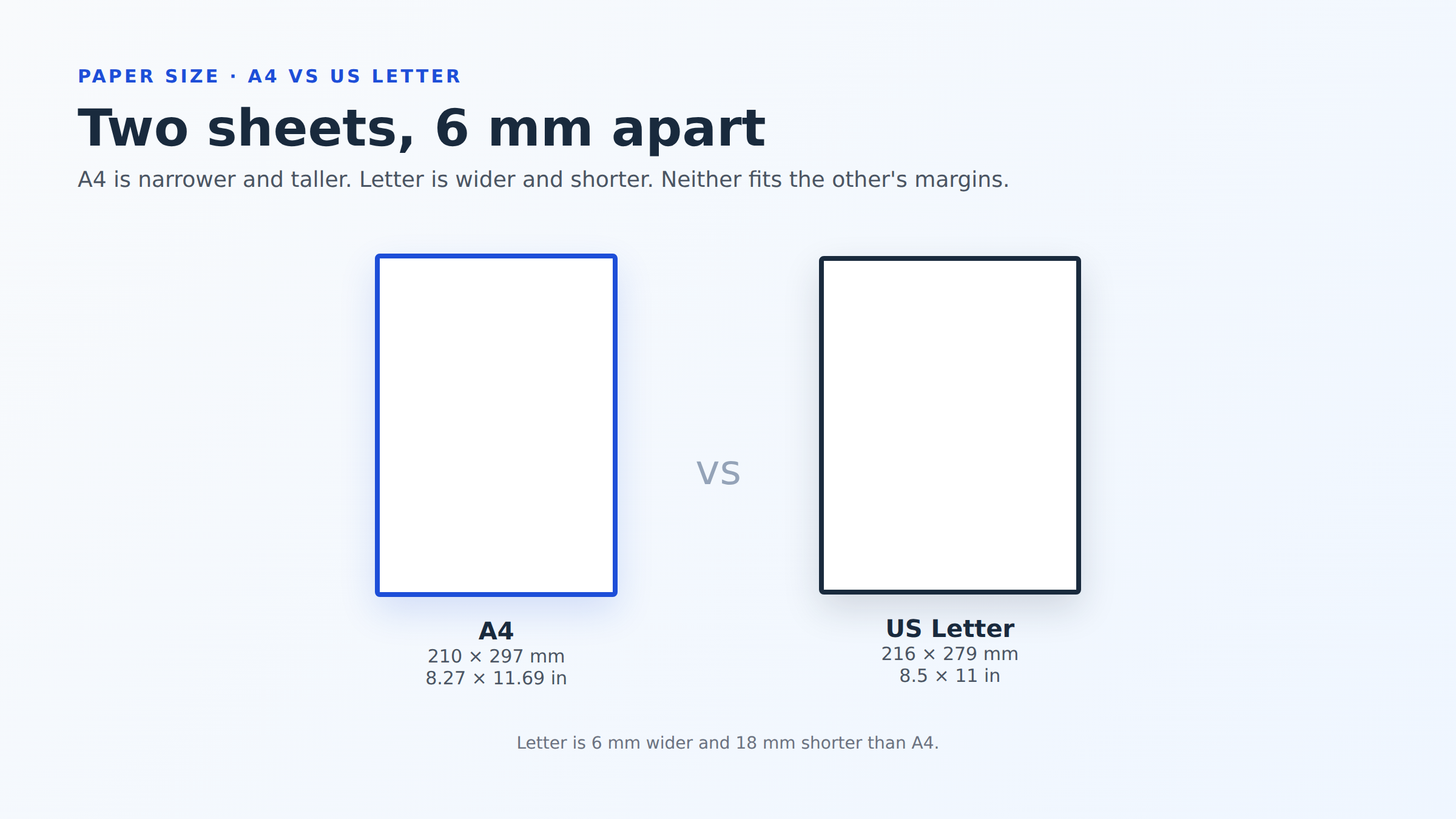
Paper size chart in inches, mm and cm
| Size | Millimetres | Centimetres | Inches | Ratio (long ÷ short) |
|---|---|---|---|---|
| A0 | 841 × 1189 mm | 84.1 × 118.9 cm | 33.11 × 46.81 in | 1.4138 |
| A1 | 594 × 841 mm | 59.4 × 84.1 cm | 23.39 × 33.11 in | 1.4158 |
| A2 | 420 × 594 mm | 42.0 × 59.4 cm | 16.54 × 23.39 in | 1.4143 |
| A3 | 297 × 420 mm | 29.7 × 42.0 cm | 11.69 × 16.54 in | 1.4141 |
| A4 | 210 × 297 mm | 21.0 × 29.7 cm | 8.27 × 11.69 in | 1.4143 |
| A5 | 148 × 210 mm | 14.8 × 21.0 cm | 5.83 × 8.27 in | 1.4189 |
| A6 | 105 × 148 mm | 10.5 × 14.8 cm | 4.13 × 5.83 in | 1.4095 |
| US Letter | 215.9 × 279.4 mm | 21.59 × 27.94 cm | 8.5 × 11 in | 1.2941 |
| US Legal | 215.9 × 355.6 mm | 21.59 × 35.56 cm | 8.5 × 14 in | 1.6471 |
| Tabloid / Ledger | 279.4 × 431.8 mm | 27.94 × 43.18 cm | 11 × 17 in | 1.5455 |
| US Executive | 184.1 × 266.7 mm | 18.41 × 26.67 cm | 7.25 × 10.5 in | 1.4483 |
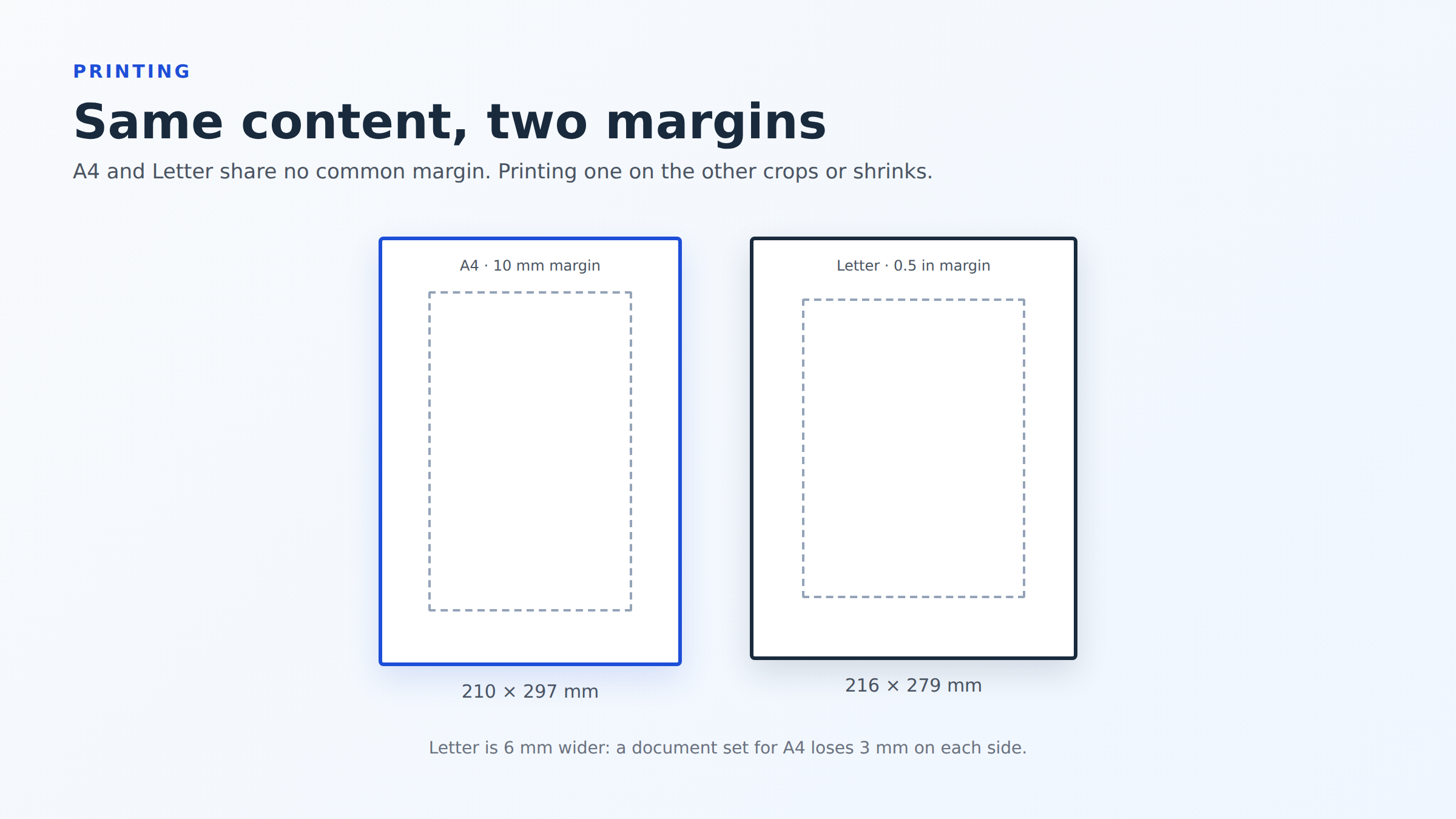
The A-series figures are exact by definition: ISO 216 specifies them in whole millimetres, and the inch values are conversions at 25.4 mm to the inch. The North American sizes work the other way round — they are defined in whole inches, so their millimetre values carry the decimals.
The √2 rule behind the A series
Where 841 × 1189 comes from
A0 is defined by two conditions: its area is one square metre, and its long side divided by its short side is √2 (1.414214). Solving the two together gives a short side of 2−1/4 m = 0.8409 m and a long side of 21/4 m = 1.1892 m. Rounded to whole millimetres, that is 841 × 1189 mm.
Why halving preserves the shape
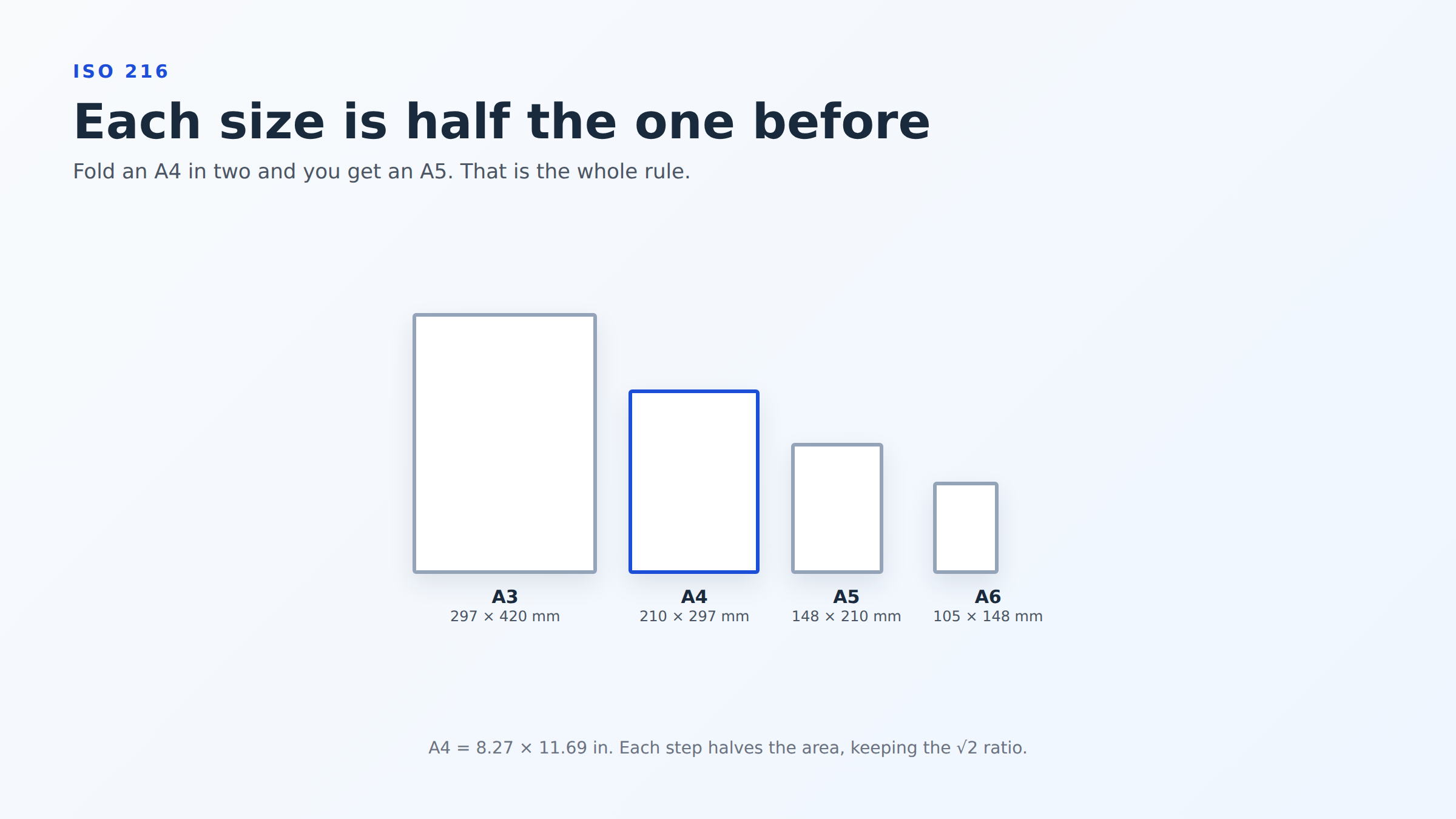
Take any sheet whose long side is √2 times its short side, and cut it in half across the long side. The new short side is the old long side halved; the new long side is the old short side. The ratio of the new sheet is the same √2. This is the only ratio for which that is true, and it is why A4 folded in half is exactly A5 and not an approximation of it.
Each step down halves the area: A0 is 1 m², A1 is 1/2 m², A4 is 1/16 m² (0.0625 m², or 62,370 mm² after the millimetre rounding). Each step down also divides the length by √2, which is 1.414214, so the linear scale between neighbouring sizes is always 70.7% or 141.4%.
What that buys you in practice
| Change | Scale factor | Exact value | Result |
|---|---|---|---|
| A4 → A3 (one size up) | 141.4% | √2 | Exact: no content is lost or added |
| A4 → A5 (one size down) | 70.7% | 1 ÷ √2 | Exact |
| A4 → A2 (two sizes up) | 200.0% | 2 | Exact: area doubles twice, length doubles once |
| A4 → A6 (two sizes down) | 50.0% | 1 ÷ 2 | Exact |
| A4 → US Letter | 94.1% | 279.4 ÷ 297 | Height is the limit; 9.2 mm of blank width is added each side |
| US Letter → A4 | 97.3% | 210 ÷ 215.9 | Width is the limit; 12.6 mm of blank height is added top and bottom |
The first four rows are exact; the last two are not, and cannot be, because Letter and A4 are different shapes. Scaling between them always leaves a blank strip on one axis.
A4 vs US Letter: the exact difference
| Measurement | A4 | US Letter | Difference |
|---|---|---|---|
| Width | 8.268 in (210 mm) | 8.5 in (215.9 mm) | Letter is 0.232 in (5.9 mm) wider |
| Height | 11.693 in (297 mm) | 11 in (279.4 mm) | A4 is 0.693 in (17.6 mm) taller |
| Area | 96.67 sq in (62370 mm²) | 93.50 sq in (60322.5 mm²) | A4 is 3.39% larger |
| Ratio (long ÷ short) | 1.4143 (√2) | 1.2941 (17 ÷ 13.14…) | A4 is the more elongated shape |
| Diagonal | 14.32 in (363.7 mm) | 13.90 in (353.1 mm) | A4 is longer corner to corner |
What happens when you print one on the other
Send an A4 document to a printer loaded with Letter and ask for fit-to-page, and the software scales by the smaller of the two fits. Height is the binding constraint: 279.4 ÷ 297 = 0.9407, so the page prints at 94.1%. Everything on it — type size, line spacing, image widths — shrinks by six percent, and a 9.2 mm blank strip appears down each side.
The reverse is milder. Letter onto A4 is limited by width: 210 ÷ 215.9 = 0.9727, printing at 97.3%, with 12.6 mm of blank added at the top and bottom.
Why it matters beyond the blank strip
- Anything measured on the page is now wrong. A ruler printed at 94.1% is not a ruler. A scale drawing stops being to scale. A form with fixed-width boxes no longer matches what is meant to go in them.
- Fonts lose their nominal size. 12 pt set on A4 arrives as 11.3 pt on Letter. Over a long document that changes the page count.
- Without fit-to-page, content is clipped instead. Printing A4 at 100% on Letter cuts 17.6 mm (0.693 in) off the bottom — normally the footer and the page number.
- Margins stop being symmetrical. Fit-to-page centres the scaled image, so a layout designed with a wide binding margin on one side ends up with that asymmetry plus an even blank strip on both.
The reliable fix is to set the page size in the document to the paper that is actually in the tray, rather than relying on the printer to rescale.
Common print margins
Margins are set in the document, not in the paper standard. These are the presets in wide use, with the text area each one leaves:
| Margin preset | Top / bottom | Left / right | Text area on Letter | Text area on A4 |
|---|---|---|---|---|
| 1 inch all round | 1 in / 25.4 mm | 1 in / 25.4 mm | 6.50 × 9.00 in | 6.27 × 9.69 in |
| 0.75 inch all round | 0.75 in / 19.1 mm | 0.75 in / 19.1 mm | 7.00 × 9.50 in | 6.77 × 10.19 in |
| 0.5 inch all round (narrow) | 0.5 in / 12.7 mm | 0.5 in / 12.7 mm | 7.50 × 10.00 in | 7.27 × 10.69 in |
| 2 cm all round | 0.787 in / 20 mm | 0.787 in / 20 mm | 6.93 × 9.43 in | 6.69 × 10.12 in |
| 2.5 cm all round | 0.984 in / 25 mm | 0.984 in / 25 mm | 6.53 × 9.03 in | 6.30 × 9.72 in |
| Moderate (1 in / 0.75 in) | 1 in / 25.4 mm | 0.75 in / 19.1 mm | 7.00 × 9.00 in | 6.77 × 9.69 in |
Note what the table shows about swapping paper: a 1-inch margin on Letter leaves a text block 6.50 in wide, while the same margin on A4 leaves 6.27 in — 0.23 in narrower and 0.69 in taller. A layout tuned to one will reflow on the other even when the margins are nominally identical.
The margin the printer imposes
Separate from the document margin, the hardware keeps an unprintable border. Typical figures for sheet-fed home and office printers:
| Edge | Typical unprintable border | In inches |
|---|---|---|
| Left, right, leading | 3–5 mm | 0.12–0.20 in |
| Trailing (bottom as fed) | 9–15 mm | 0.35–0.59 in |
| Borderless mode | 0 mm | 0 in — achieved by printing oversize and overspraying the edge |
This is why a document with 5 mm margins can come out with one edge clipped while the other three print. Keep live content at least 6 mm (0.24 in) from every edge, and 15 mm (0.59 in) from the bottom, unless the printer is known to do better.
Legal, Tabloid and Executive
- US Legal — 8.5 × 14 in (215.9 × 355.6 mm). The same width as Letter, 3 inches (76.2 mm) longer. Because the width matches, a Letter layout prints on Legal at 100% with 3 inches of empty paper at the foot.
- Tabloid, also called Ledger — 11 × 17 in (279.4 × 431.8 mm). Exactly two Letter sheets side by side, so it is the US equivalent of the A3-to-A4 relationship, though without the √2 ratio: Tabloid’s ratio is 1.5455 against Letter’s 1.2941. Tabloid is the sheet in portrait, Ledger the same sheet in landscape.
- US Executive — 7.25 × 10.5 in (184.15 × 266.7 mm). Smaller than Letter on both axes, by 1.25 in of width and 0.5 in of height.
The closest A-series neighbour to Letter is A4; the closest to Tabloid is A3 (297 × 420 mm, 11.69 × 16.54 in), which is 0.69 in taller and 0.46 in narrower.
Why A4 in inches is never a round number
A4 is defined in millimetres, so every inch figure for it is a conversion and carries a remainder. 210 mm is 8.2677 in and 297 mm is 11.6929 in. Rounding to 8.27 × 11.69 in loses 0.08 mm on the width and 0.03 mm on the height — invisible. Rounding harder does real damage:
- 8.3 × 11.7 in overstates A4 by 0.8 mm in width and 0.2 mm in height.
- 8¼ × 11¾ in (8.25 × 11.75) is 0.45 mm narrow and 1.45 mm tall.
- 8½ × 11 in is not a rounding of A4 at all. It is US Letter, a different sheet.
For layout work, set the page in millimetres when the target is an A size and in inches when the target is a US size. Converting the page size itself is where sub-millimetre errors creep into bleed and crop marks.
Envelope sizes that take A-series sheets
The C series, defined alongside the A series, is sized so that an A sheet slides into the C envelope of the same number. Each C size is the geometric mean of the A and B sizes that share its number, which makes it just large enough.
| Envelope | Millimetres | Inches | Takes |
|---|---|---|---|
| C4 | 229 × 324 mm | 9.02 × 12.76 in | A4 unfolded |
| C5 | 162 × 229 mm | 6.38 × 9.02 in | A4 folded once (A5) |
| C6 | 114 × 162 mm | 4.49 × 6.38 in | A4 folded twice (A6) |
| DL | 110 × 220 mm | 4.33 × 8.66 in | A4 folded in three |
DL is the odd one out: it is not a C size and does not follow the √2 ratio. Its 110 × 220 mm is built around an A4 sheet folded in three, each panel 99 mm tall, with clearance.
More measurements
- Inches to cm converter: any length in inches, with a 1–100 inch chart
- Cm to inches converter: the same conversion the other way
- Instagram post size in inches: pixel dimensions turned into print sizes at 72, 150 and 300 dpi
- Ring size chart in inches and mm: US 1 to 15 with UK, EU and JP equivalents
FAQs
A4 is 8.27 × 11.69 inches, from the defined size of 210 × 297 mm. To four decimals the conversion is 8.2677 × 11.6929 in.
A4 is 0.693 in (17.6 mm) taller and 0.232 in (5.9 mm) narrower than US Letter. By area A4 is larger: 62,370 mm² against 60,322 mm², a difference of 3.39%.
A4 comes from A0, which is defined as a sheet of 1 m² whose long side divided by its short side equals the square root of 2. That gives A0 = 841 × 1189 mm. Halving across the long side four times gives A4, and the √2 ratio survives every halving.
141.4%, the square root of 2. The reverse, A3 to A4, is 70.7%. Because the ratio is preserved, the enlargement is exact and nothing is cropped or padded.
US Legal is 8.5 × 14 inches, which is 215.9 × 355.6 mm exactly. It shares its width with US Letter and is 3 inches (76.2 mm) longer.
Most cannot. A typical sheet-fed printer holds an unprintable border of about 3 to 5 mm on three sides and often 9 to 15 mm at the trailing edge, where the rollers release the sheet. Borderless modes work by printing slightly oversize and letting the excess fall off the edge.
To convert any other sheet size, use the inches to cm converter or the cm to inches converter.