

Published
A US men’s size 9 fits a foot 10.33 inches (26.2 cm) long; a US women’s size 8 fits a foot 9.67 inches (24.6 cm) long. Both scales move in steps of one third of an inch — 0.333 in, or 8.47 mm — per full size, and half that per half size. The charts below give US, UK and EU sizes against foot length in inches and centimetres.
One number is worth fixing before reading the chart: a half size is 1/6 inch, 4.23 mm. A sloppy measurement of the foot, off by 5 mm, is already more than a half size out.
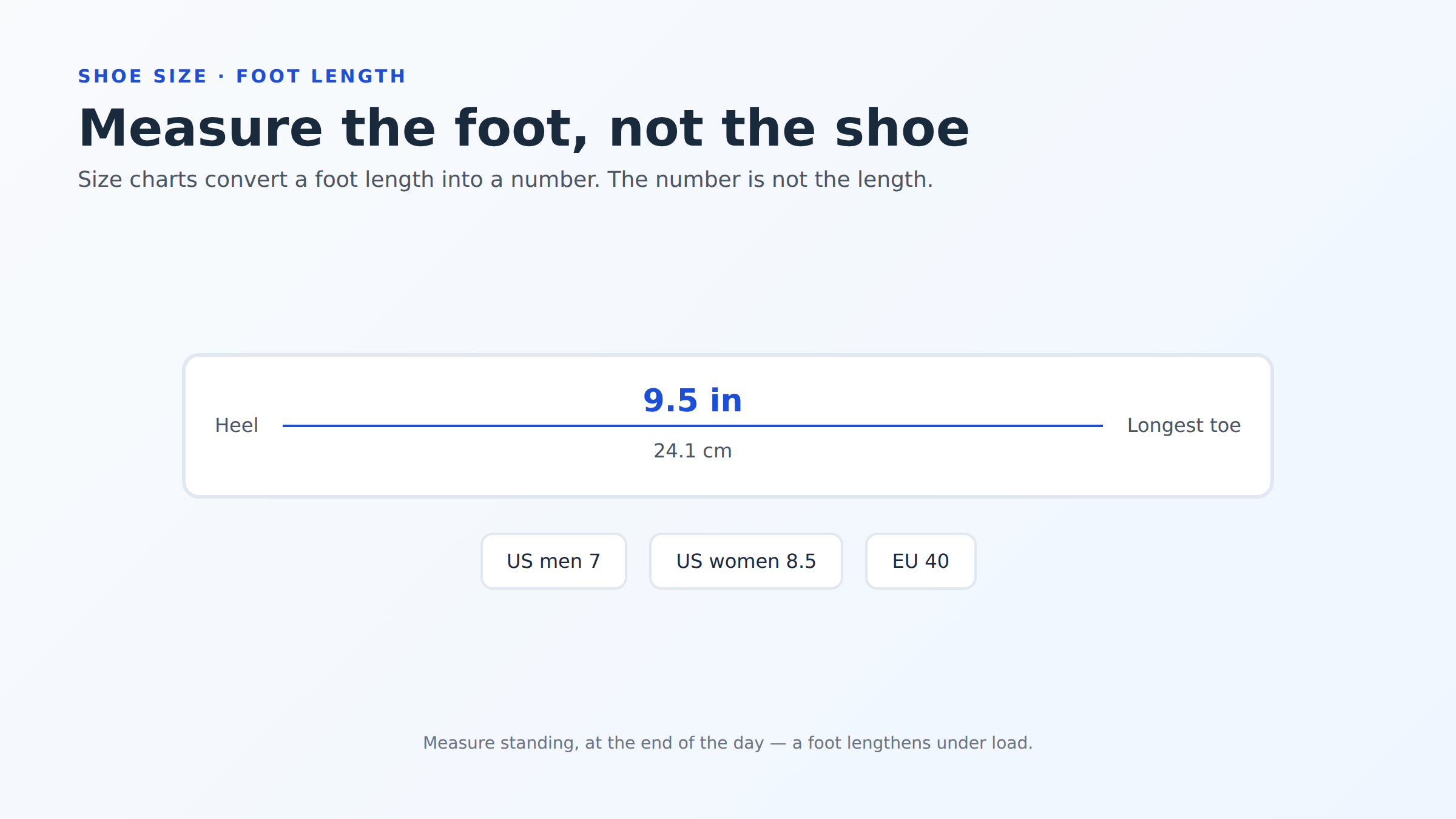
Women’s shoe size chart in inches and cm
| US size | UK size | EU size | Foot length (in) | Foot length (cm) |
|---|---|---|---|---|
| 4 | 2 | 34 | 8.33 in (8 5/16) | 21.2 cm |
| 4.5 | 2.5 | 35 | 8.50 in (8 1/2) | 21.6 cm |
| 5 | 3 | 35 | 8.67 in (8 11/16) | 22.0 cm |
| 5.5 | 3.5 | 36 | 8.83 in (8 13/16) | 22.4 cm |
| 6 | 4 | 37 | 9.00 in (9) | 22.9 cm |
| 6.5 | 4.5 | 37 | 9.17 in (9 3/16) | 23.3 cm |
| 7 | 5 | 38 | 9.33 in (9 5/16) | 23.7 cm |
| 7.5 | 5.5 | 38 | 9.50 in (9 1/2) | 24.1 cm |
| 8 | 6 | 39 | 9.67 in (9 11/16) | 24.6 cm |
| 8.5 | 6.5 | 40 | 9.83 in (9 13/16) | 25.0 cm |
| 9 | 7 | 40 | 10.00 in (10) | 25.4 cm |
| 9.5 | 7.5 | 41 | 10.17 in (10 3/16) | 25.8 cm |
| 10 | 8 | 42 | 10.33 in (10 5/16) | 26.2 cm |
| 10.5 | 8.5 | 42 | 10.50 in (10 1/2) | 26.7 cm |
| 11 | 9 | 43 | 10.67 in (10 11/16) | 27.1 cm |
| 11.5 | 9.5 | 44 | 10.83 in (10 13/16) | 27.5 cm |
| 12 | 10 | 44 | 11.00 in (11) | 27.9 cm |
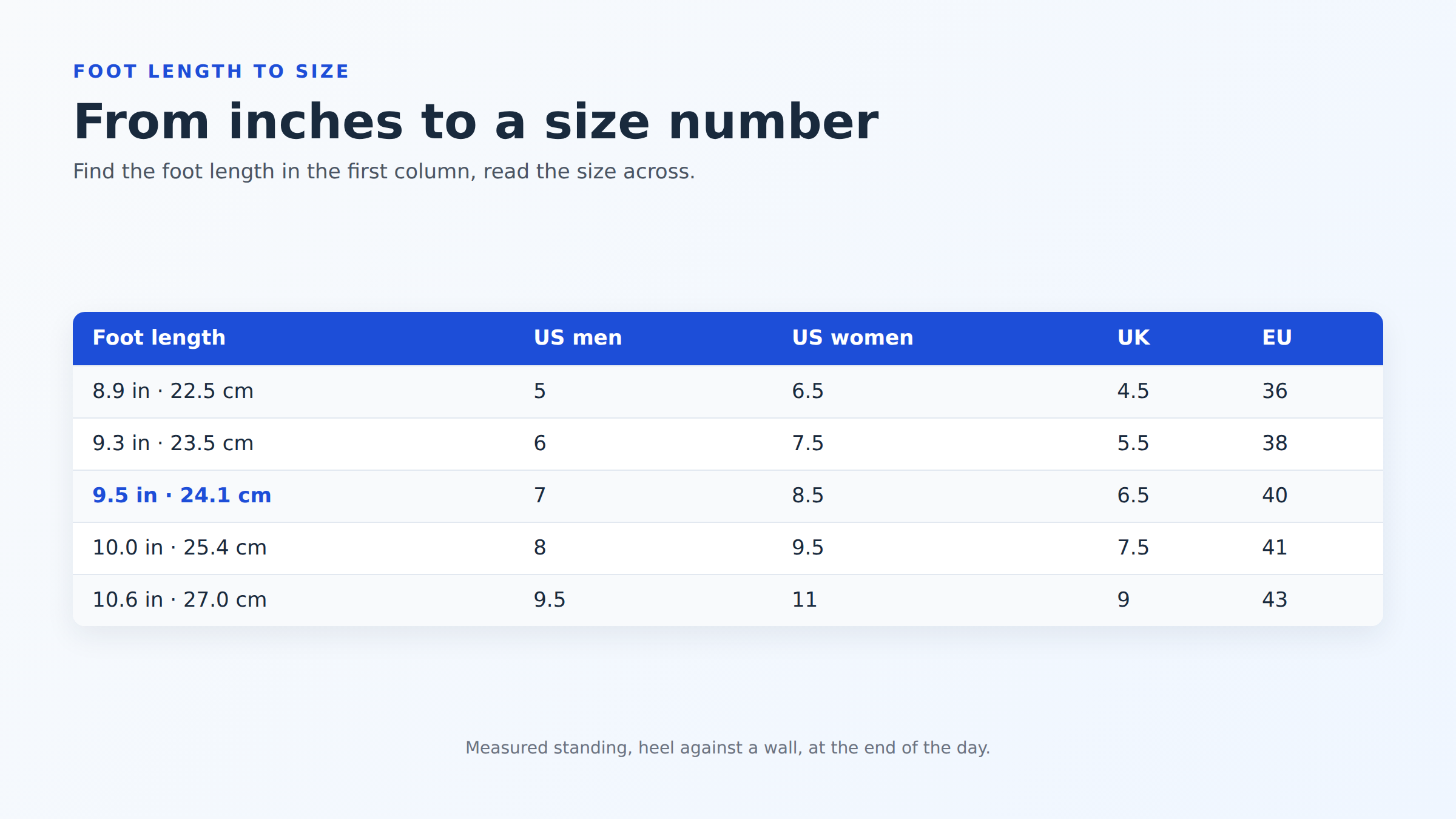
Men’s shoe size chart in inches and cm
| US size | UK size | EU size | Foot length (in) | Foot length (cm) |
|---|---|---|---|---|
| 6 | 5 | 38 | 9.33 in (9 5/16) | 23.7 cm |
| 6.5 | 5.5 | 38 | 9.50 in (9 1/2) | 24.1 cm |
| 7 | 6 | 39 | 9.67 in (9 11/16) | 24.6 cm |
| 7.5 | 6.5 | 40 | 9.83 in (9 13/16) | 25.0 cm |
| 8 | 7 | 40 | 10.00 in (10) | 25.4 cm |
| 8.5 | 7.5 | 41 | 10.17 in (10 3/16) | 25.8 cm |
| 9 | 8 | 42 | 10.33 in (10 5/16) | 26.2 cm |
| 9.5 | 8.5 | 42 | 10.50 in (10 1/2) | 26.7 cm |
| 10 | 9 | 43 | 10.67 in (10 11/16) | 27.1 cm |
| 10.5 | 9.5 | 44 | 10.83 in (10 13/16) | 27.5 cm |
| 11 | 10 | 44 | 11.00 in (11) | 27.9 cm |
| 11.5 | 10.5 | 45 | 11.17 in (11 3/16) | 28.4 cm |
| 12 | 11 | 45 | 11.33 in (11 5/16) | 28.8 cm |
| 12.5 | 11.5 | 46 | 11.50 in (11 1/2) | 29.2 cm |
| 13 | 12 | 47 | 11.67 in (11 11/16) | 29.6 cm |
| 13.5 | 12.5 | 47 | 11.83 in (11 13/16) | 30.1 cm |
| 14 | 13 | 48 | 12.00 in (12) | 30.5 cm |
| 14.5 | 13.5 | 49 | 12.17 in (12 3/16) | 30.9 cm |
| 15 | 14 | 49 | 12.33 in (12 5/16) | 31.3 cm |
The UK column follows the fixed offsets built into the scales: a UK men’s size is one number below the US men’s size, and a UK women’s size is two numbers below the US women’s size. The EU column is calculated, not fixed — see below for why it is the least reliable column in any shoe chart.
How the three scales are defined
US and UK: thirds of an inch
Both the US and UK scales come from the barleycorn, an old length unit of 1/3 inch. That is still the step: one full size is 1/3 in (8.47 mm), one half size is 1/6 in (4.23 mm). The scales differ only in where they start.
- US men’s: foot length (in) = (size + 22) ÷ 3
- US women’s: foot length (in) = (size + 21) ÷ 3
- UK men’s: US men’s size − 1
- UK women’s: US women’s size − 2
Reversed, the same relations give the size from a measured foot: US men’s size = (3 × foot length in inches) − 22, and US women’s size = (3 × foot length in inches) − 21.
EU: Paris points
The European scale counts Paris points. One Paris point is 2/3 cm — 6.667 mm, or 0.262 inch. The size is the length of the last in Paris points, so EU size = last length in cm × 1.5.
Two consequences follow. First, a European size step is 6.67 mm against 8.47 mm for a US size step, so the two scales never line up for long: three EU sizes cover almost exactly the same ground as two and a half US sizes. Second, the Paris point has no halves. A shoe marked 41.5 is not half a Paris point; it is a last the maker has placed between two points, and where exactly it sits is the maker’s choice.
The EU numbers in the charts above are calculated from foot length plus a 1.5 cm toe allowance, which is a common figure for a closed shoe. A maker working to a 1 cm allowance will label the same foot one size smaller.
How to measure your feet
- Measure late in the day. Feet lengthen over a day of standing and walking, and the swing is often 3 to 5 mm — around half a size.
- Put a sheet of paper on a hard floor with one short edge against a wall, and wear the socks you intend to wear with the shoes.
- Stand on the paper with your heel touching the wall and your weight on that foot. A loaded foot spreads and lengthens; measuring while seated reads short.
- Mark the paper at the tip of the longest toe, holding the pencil upright. The longest toe is not always the big toe.
- Measure from the wall edge to the mark, in millimetres.
- Repeat for the other foot.
Feet are rarely the same length; a difference of 3 to 6 mm between left and right is ordinary. Size to the longer foot. A shoe that is slightly roomy can be adjusted with lacing or an insole; one that is short cannot be fixed.
Width matters as much as length and is not in the size number at all on most scales. If a shoe in the right length feels tight across the ball of the foot, the problem is width, and going up in length will not solve it — it will only move the flex point of the shoe past the joint where the foot actually bends.
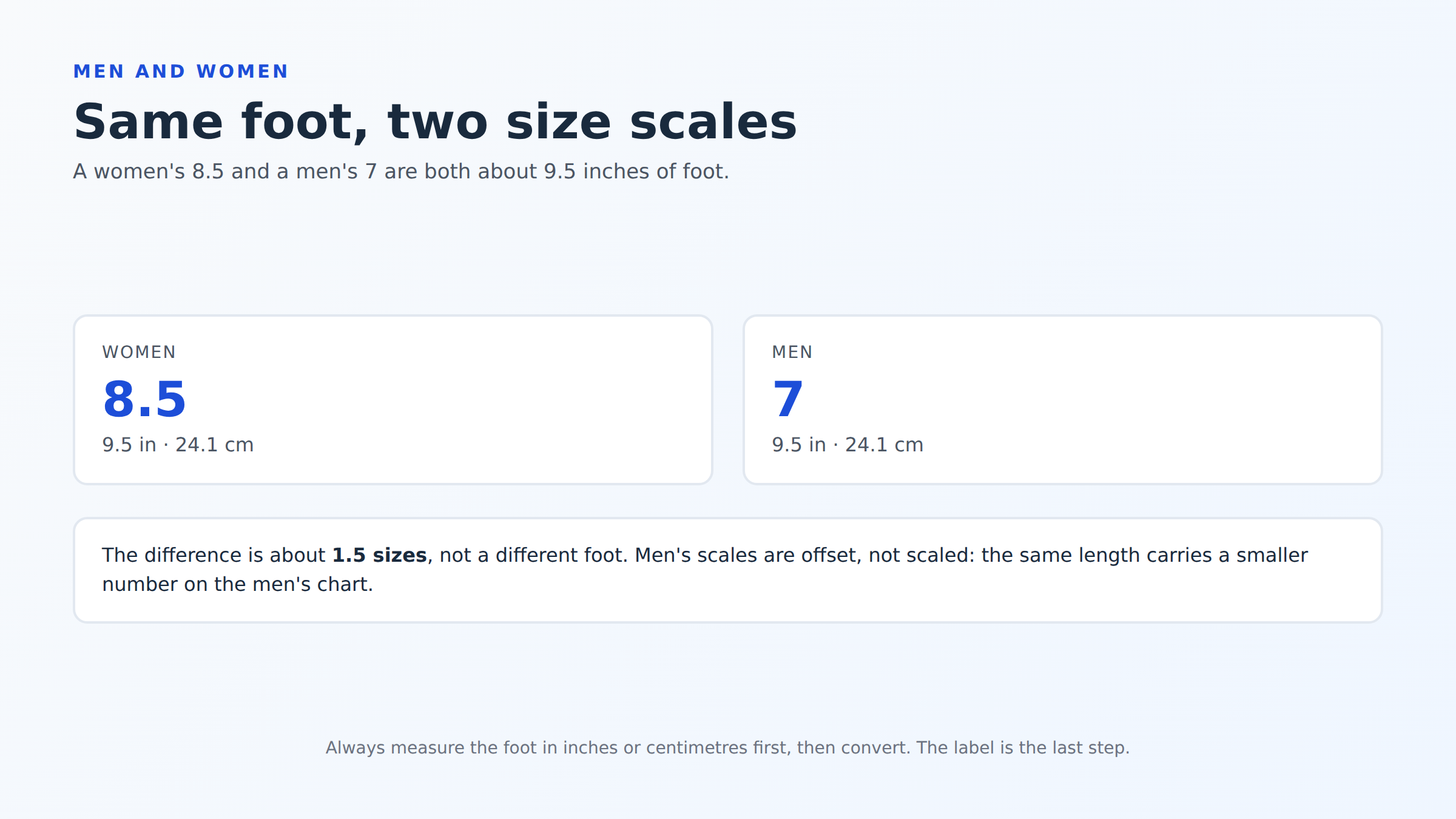
A worked example
Take a foot measured at 26.8 cm, which is 10.55 inches. The US men’s formula gives (3 × 10.55) − 22 = 9.65, so the foot falls between two half sizes:
- US 9½ is built for a 10.50 in (26.67 cm) foot — 1.3 mm short of the measurement.
- US 10 is built for a 10.67 in (27.09 cm) foot — 2.9 mm longer than the measurement.
Neither is exact, because the foot does not land on a size; nothing does. The half size below is short by less, but the shortfall comes straight out of the toe allowance, which is the part of the shoe that absorbs the foot lengthening under load. The size above gives that allowance back. On a measurement that falls between sizes, the larger number is the safer one, and this is the arithmetic behind the common advice to round up.
The same foot in the women’s scale is (3 × 10.55) − 21 = 10.65, so US women’s 11; in the UK scale, men’s 9 or women’s 9; in Paris points, (26.8 + 1.5) × 1.5 = 42.5, which is between EU 42 and 43.
Why the size number is not the length of your foot
A size chart maps a size to a foot length, but the shoe is not built on a foot. It is built on a last: a solid form, longer than the foot that will go in it. The difference is the toe allowance, usually 1 to 1.5 cm (0.4 to 0.6 in) in a closed shoe.
The allowance is not padding. A foot under load lengthens by several millimetres as the arch flattens, and the toes need to stay clear of the front of the shoe at the end of that movement. The allowance absorbs it.
How much allowance a maker builds in is a design decision, and it changes by shoe type:
| Shoe type | Typical extra length over the foot | Effect on fit |
|---|---|---|
| Dress shoe with a pointed toe | 1.5–2.5 cm (0.6–1.0 in) | Most of the extra length is empty point ahead of the toes; the usable interior is shorter than the shoe looks. |
| Everyday closed shoe | 1.0–1.5 cm (0.4–0.6 in) | The reference case most size charts assume. |
| Running shoe | 1.0–1.5 cm (0.4–0.6 in) | Often worn half a size up, because the foot swells and slides forward on descents. |
| Sandal or open shoe | 0.3–0.8 cm (0.1–0.3 in) | Little allowance is needed when the toes are not enclosed; the same foot takes a smaller number. |
Why the same size varies between makers
Nothing in the US, UK or EU system is a legal specification. The scales define a step and a starting point; they do not define the last. Everything that decides whether a shoe fits is set by whoever built it:
- Toe allowance. A 5 mm difference in allowance between two makers is more than half a size, and 5 mm is a small design choice.
- Last shape. A narrow, tapered toe box and a rounded one can carry the same length and fit very differently.
- Width grading. Makers that offer one width only must pick a middle; feet outside it compensate by changing length.
- Half-size policy. Some ranges are made in whole sizes only, and the half sizes on the box are the whole-size last with a thicker insole.
- Conversion choice. A shoe designed on an EU last and labelled with a US number has been converted by its maker, using its own rounding.
The practical consequence: treat the size number as a starting point and the measured foot length in millimetres as the real figure. A chart that gives the length behind every size, as the ones above do, lets you compare two makers’ charts directly instead of comparing two size numbers that mean different things.
Quick conversions
- 1 shoe size = 1/3 in = 0.333 in = 8.47 mm
- 1 half size = 1/6 in = 0.167 in = 4.23 mm
- 1 Paris point (1 EU size) = 2/3 cm = 6.667 mm = 0.262 in
- 1 inch of foot length = 3 US or UK sizes = 3.81 EU sizes
- 1 cm of foot length = 1.18 US sizes = 1.5 EU sizes
More size charts
- Ring size chart in inches and mm: US 1 to 15 with UK, EU and JP equivalents
- Inches to cm converter: any length in inches, with a 1–100 inch chart
- Cm to inches converter: the same conversion the other way
FAQs
10.33 inches, or 26.2 cm. The US men’s scale puts foot length at (size + 22) ÷ 3 inches, so size 9 gives (9 + 22) ÷ 3 = 10.33 in.
Stand on a sheet of paper with your heel against a wall, with your full weight on the foot, and mark the paper at the tip of your longest toe. Measure from the wall edge of the paper to the mark. Do it late in the day and measure both feet.
Shoe sizes describe the last, the form the shoe is built on, not the foot. A last is typically 1 to 1.5 cm (0.4 to 0.6 in) longer than the foot it is meant to fit, so that the toes have room as the foot lengthens under load.
One full size is 1/3 inch, which is 0.333 in or 8.47 mm. A half size is 1/6 inch — 0.167 in or 4.23 mm.
No. On the US scales a women’s size is one number higher than the men’s size of the same foot length, because the two scales start from different points: men’s size n is (n + 22) ÷ 3 inches and women’s size n is (n + 21) ÷ 3 inches.
Because the size number describes a nominal last length and nothing else. Toe allowance, last shape, width grading, upper material and heel height all change the usable interior, and none of them appear in the size number.
To convert a foot measurement between units, use the cm to inches converter or the inches to cm converter.