

Published
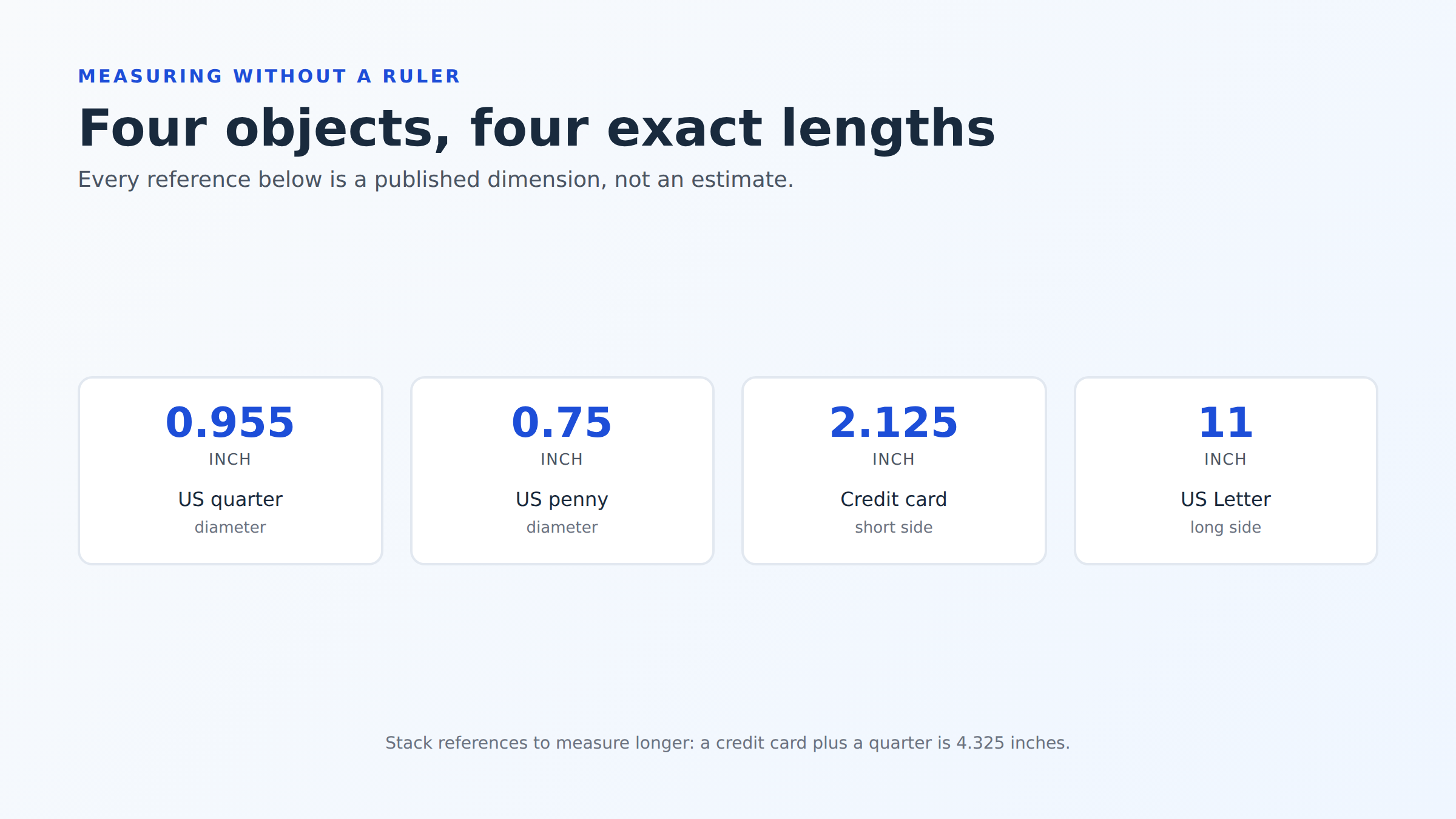
The most accurate inch reference in an average pocket is a US penny: its diameter is exactly 0.750 inch (19.05 mm), so four pennies in a row measure exactly 3.000 inches. A credit card is better still for longer spans, because its size is fixed by an international standard at 3.370 × 2.125 inches.
The nine methods below are ordered by how much you can trust them. Each one gives the exact dimension of the reference object, the accuracy to expect, and the error it accumulates over a longer measurement. One rule runs through all of them: error comes from the number of times you move the object, not from the object itself. Use the longest reference that fits the job.
The nine references at a glance
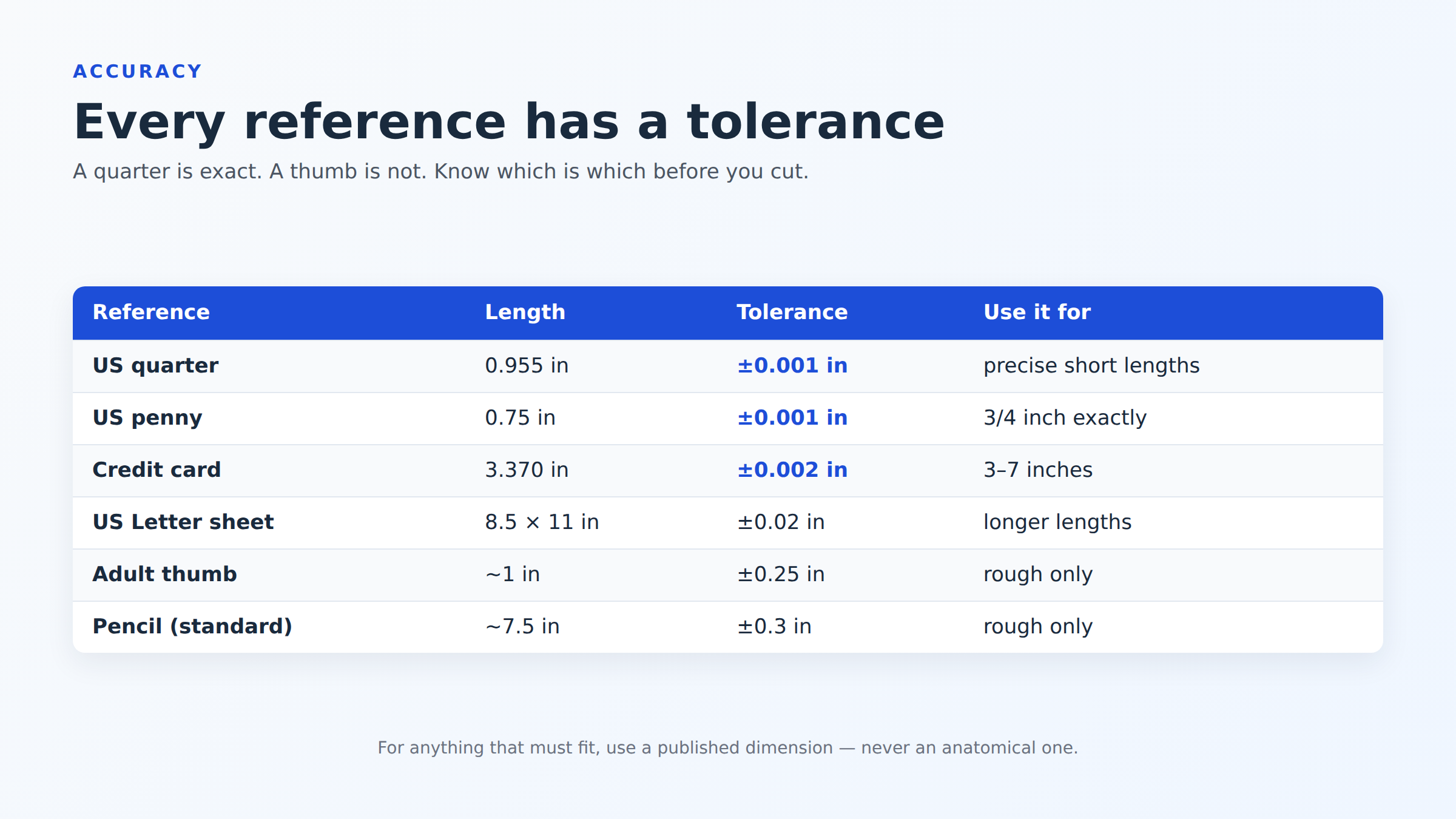
| Method | Reference dimension (in) | In mm | How fixed it is | Accuracy |
|---|---|---|---|---|
| 1. US quarter | Diameter 0.955 in | 24.26 mm | Minted to spec | ±0.5% per placement |
| 2. US penny | Diameter 0.750 in | 19.05 mm | Minted to spec | ±0.5% per placement |
| 3. Credit or ID card | 3.370 × 2.125 in | 85.60 × 53.98 mm | ISO/IEC 7810 ID-1 | ±0.2% |
| 4. US Letter sheet | 8.5 × 11 in | 215.9 × 279.4 mm | Defined in inches | ±0.3% |
| 4b. A4 sheet | 8.268 × 11.693 in | 210 × 297 mm | ISO 216 | ±0.3% |
| 5. Adult thumb tip | about 1 in | about 25 mm | Not standardised | ±15–20% |
| 6. US banknote | 6.14 × 2.61 in | 155.96 × 66.29 mm | Same for every denomination | ±0.3% |
| 7. Unsharpened pencil | 7.5 in | 190.5 mm | Convention, not a standard | ±3% |
| 8. No. 1 paperclip | 1.375 in | 34.9 mm | Convention, not a standard | ±5% |
| 9. Adult fingernail | 0.4–0.7 in | 10–18 mm | Not standardised | ±20% |
1. US quarter — 0.955 inch
A quarter is 24.26 mm across, which is 0.955 inch. That makes it the closest common coin to an inch, but it is not an inch: it falls short by 0.045 in (1.14 mm), about 4.5%.
Used once, the error is under a millimetre and usually acceptable. Used repeatedly it compounds in one direction, because the shortfall is systematic rather than random. Ten quarters in a row measure 9.55 in, not 10 — nearly half an inch short. If you need several inches from quarters, multiply first: quarters × 0.955 = inches.
A quarter is also 1.75 mm (0.069 in) thick, so a stack of 15 is 1.033 in.
2. US penny — 0.750 inch
The penny is the single most useful coin here, because its diameter is a round fraction: 19.05 mm is exactly ¾ inch, with no rounding at all. The consequences are worth memorising:
- 4 pennies = 3.000 in
- 8 pennies = 6.000 in
- 16 pennies = 12.000 in = 1 foot
- 1 penny = ¾ in = 0.75 in = 19.05 mm
This is the only everyday object that produces exact inch values by repetition, which makes it the right tool for building a scale rather than taking a single reading. Lay four pennies along the edge of a strip of paper, mark each end, and you have a 3-inch gauge that is correct to within the care you took placing them.
The expected error is about 0.3 mm per placement from alignment, so a 3-inch gauge made from four pennies is good to roughly ±1 mm, or 1%.
3. Credit card — 3.370 × 2.125 inches
Every payment card, driving licence and ID card in the ID-1 format is specified by ISO/IEC 7810 at 85.60 × 53.98 mm, which converts to 3.3701 × 2.1252 inches. The tolerance in the standard is a few hundredths of a millimetre, so a card is effectively a calibrated object that most people carry.
- Long side: 3.370 in. Three card lengths come to 10.11 in.
- Short side: 2.125 in — exactly 2⅛ inches, to within 0.005 mm.
- Corner radius: 3.18 mm (0.125 in), which is exactly ⅛ inch.
- Thickness: 0.76 mm (0.0299 in). A stack of 33 cards is 1.00 inch.
Accuracy is about ±0.2% on a single placement, the best of any object here. For anything between 2 and 10 inches, this is the reference to reach for.
4. A sheet of paper — US Letter 8.5 × 11 in, A4 8.268 × 11.693 in
Paper is the largest accurate reference most rooms contain. US Letter is defined in inches, so its 8.5 × 11 in figure is exact by definition. A4 is defined in millimetres at 210 × 297 mm, giving 8.2677 × 11.6929 in.
Folding gives you submultiples without any measuring:
| Fold | US Letter | A4 |
|---|---|---|
| Unfolded | 8.5 × 11 in | 8.268 × 11.693 in |
| Folded once (short way) | 8.5 × 5.5 in | 8.268 × 5.846 in (A5) |
| Folded twice | 4.25 × 5.5 in | 4.134 × 5.846 in |
| Folded three times | 4.25 × 2.75 in | 4.134 × 2.923 in |
| Short edge folded in eighths | 1.0625 in per segment | 1.0335 in per segment |
Note the last row: folding the short edge of a Letter sheet three times gives segments of 1.0625 in, which is 6.25% over an inch, not an inch. Folding is exact; what it produces is only an inch if the starting edge happens to divide into inches, and 8.5 does not divide into 8 evenly.
Accuracy is around ±0.3%, limited by how square the folds are rather than by the paper. Each fold adds roughly 0.5 mm of slop at the crease.
5. The tip of an adult thumb — about 1 inch
The segment from the thumb knuckle to the tip is the origin of the inch and is still the most quoted substitute for one. It is also the worst reference on this list. Adult thumb tips run roughly 0.8 to 1.2 inches, so the honest error is 15 to 20%, and the bias stays in the same direction for any given hand.
It becomes useful only after calibration. Measure your own thumb tip once against a card or four pennies, write the figure down, and from then on it is a known length instead of an assumption. A thumb of 1.08 in used as 1 in is a 0.96 in error over a foot — about a centimetre.
6. US banknote — 6.14 × 2.61 inches
Every US banknote in circulation, from $1 to $100, is the same size: 6.14 × 2.61 inches (155.96 × 66.29 mm). Denomination makes no difference, which is what makes a bill dependable.
At 6.14 in the long side is the best mid-range reference after a sheet of paper, and it is a near-miss for half a foot: a bill is 2.3% longer than 6 inches, overshooting by 0.14 in (3.6 mm). Two bills end to end are 12.28 in against a foot’s 12 — close enough to spot a problem, not close enough to cut to.
A bill is about 0.0043 in (0.11 mm) thick, so a stack of 233 is roughly an inch. Expect ±0.3% accuracy from a flat, uncreased note; a worn or folded one reads short.
7. A standard pencil — 7.5 inches
An unsharpened wood pencil is conventionally 7.5 inches (190.5 mm) long. This is a convention of the trade and not a published standard, so treat it as 7.5 in ±3%, roughly a quarter of an inch either way.
Two caveats apply. Sharpening removes an unknown amount, so only a new pencil carries the figure; and the hexagonal body is about 7 mm (0.276 in) across the flats and 8 mm across the corners.
Where the pencil wins is reach: for a span of 6 to 8 inches it does the job in one placement, and one placement of a ±3% object beats eight placements of a ±0.5% one.
8. A paperclip — 1.375 inches
The standard No. 1 or “Gem” paperclip is about 1.375 in (34.9 mm) long and 0.5 in (13 mm) wide. The jumbo size is about 1.97 in (50 mm). Neither is standardised, so the real variation between boxes is around 5%.
The paperclip earns its place for a different reason: unbent, it is a length of wire you can straighten into a 3 to 4 inch marker, and it holds a shape. Bent to a known length against a card, it becomes a reusable gauge for a space too tight for paper.
As a direct reference, expect ±5%, or about 0.07 in per placement.
9. A fingernail — 0.4 to 0.7 inch
An adult index fingernail is roughly 0.4 in (10 mm) across and a thumbnail roughly 0.6 to 0.7 in (15 to 18 mm). The variation between people is 20% or more, so this is a last resort.
Its one advantage is resolution. Where a thumb tip is too coarse to judge a quarter inch, a nail edge gives a usable mark for small distances, and it is always present. Calibrate it once against a penny — the nail is close to half a penny width —.
How to combine objects for a longer measurement
Cumulative error, not the object, is what ruins a long measurement. Three rules follow from that:
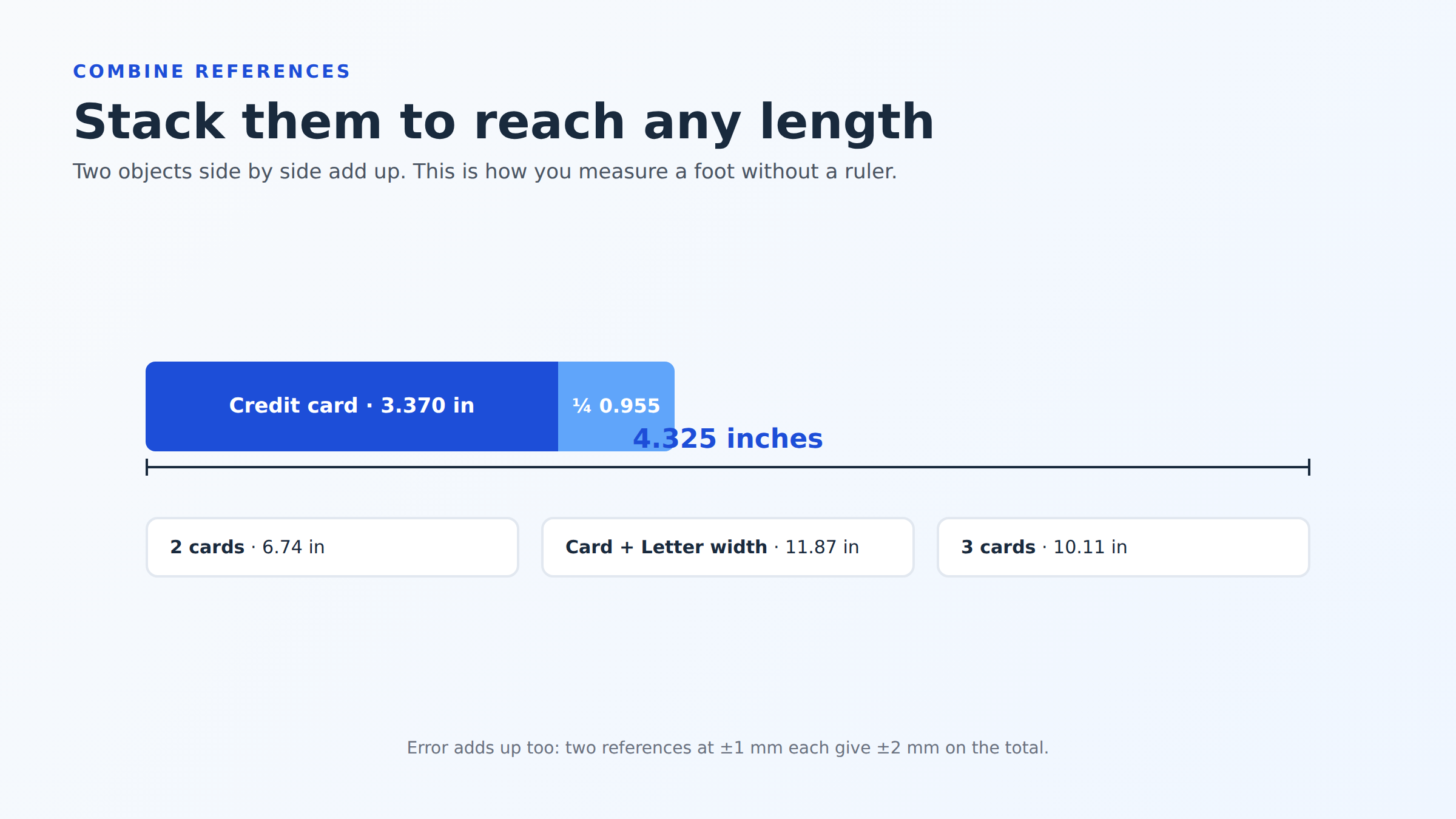
- Pick the longest reference that fits. Measuring 10 inches with a credit card is three placements; with a quarter it is ten. Even though the card and the coin have similar single-placement accuracy, the card ends up three times more accurate.
- Mix sizes to land on the target exactly. Combinations are more precise than repetitions of one object. 10 in = two Letter sheet widths (8.5) plus two pennies (1.5) = 10.000 in exactly. 5 in = two credit card short sides (4.25) plus one penny (0.75) = 5.000 in exactly.
- Transfer to paper instead of counting in air. Lay the objects along the edge of a strip of paper, mark each boundary with a pencil held upright, and read the strip. A mark made on paper cannot drift; a finger holding a place can.
Some exact combinations worth knowing, all of which come out to whole or half inches:
| Target | Combination | Exact total | Error |
|---|---|---|---|
| 1.5 in | 2 pennies | 1.500 in | 0 |
| 3 in | 4 pennies | 3.000 in | 0 |
| 4.25 in | 2 credit card short sides | 4.250 in | 0 |
| 5 in | 2 card short sides + 1 penny | 5.000 in | 0 |
| 6 in | 8 pennies | 6.000 in | 0 |
| 8.5 in | 1 Letter sheet, short edge | 8.500 in | 0 |
| 11 in | 1 Letter sheet, long edge | 11.000 in | 0 |
| 12 in | 16 pennies | 12.000 in | 0 |
The one reference that makes all of this work is the penny, because 0.75 is a clean fraction. Any target that is a multiple of a quarter inch can be hit exactly with pennies and cards alone.
How much error to expect
Figures below assume a careful but ordinary measurement: the object placed flat, each new position marked before the object is moved, and the result read in good light.
| Reference | Length | Placements for 12 in | Error per placement | Error over 12 in |
|---|---|---|---|---|
| Credit card, long side | 3.370 in | 4 placements | ±0.3% | ±0.04 in (1 mm) |
| US Letter sheet, long side | 11 in | 2 placements | ±0.3% | ±0.04 in (1 mm) |
| US banknote, long side | 6.14 in | 2 placements | ±0.4% | ±0.05 in (1.2 mm) |
| Unsharpened pencil | 7.5 in | 2 placements | ±3% | ±0.36 in (9 mm) |
| US quarter | 0.955 in | 13 placements | ±1.5% | ±0.18 in (4.5 mm) |
| US penny | 0.750 in | 16 placements | ±1.8% | ±0.22 in (5.5 mm) |
| No. 1 paperclip | 1.375 in | 9 placements | ±5% | ±0.6 in (15 mm) |
| Adult thumb tip | 1 in | 12 placements | ±18% | ±2.2 in (55 mm) |
Two things stand out. A long, slightly imprecise object beats a short, precise one over distance — the pencil at ±3% ends up more accurate over a foot than the penny at ±0.5%, purely because it is used twice instead of sixteen times. And the thumb is in a different category altogether: a two-inch error over a foot is not a measurement.
Reference coin sizes
All US circulating coins, for when one of them is what you have:
| Coin | Diameter (in) | Diameter (mm) | Thickness (in) | Thickness (mm) |
|---|---|---|---|---|
| Penny (1¢) | 0.750 in | 19.05 mm | 0.0598 in | 1.52 mm |
| Dime (10¢) | 0.705 in | 17.91 mm | 0.0531 in | 1.35 mm |
| Nickel (5¢) | 0.835 in | 21.21 mm | 0.0768 in | 1.95 mm |
| Quarter (25¢) | 0.955 in | 24.26 mm | 0.0689 in | 1.75 mm |
| Half dollar (50¢) | 1.205 in | 30.61 mm | 0.0846 in | 2.15 mm |
| Dollar coin | 1.043 in | 26.49 mm | 0.0787 in | 2.00 mm |
The half dollar is the only US coin wider than an inch, at 1.205 in. The dollar coin, at 1.043 in, is the closest of all of them to an exact inch — within 4.3%, slightly better than the quarter’s 4.5% on the other side.
More measurement guides
- Inches to cm converter: any length in inches, with a 1–100 inch chart
- Cm to inches converter: the same conversion the other way
- Paper size chart in inches and mm: every A size plus Letter, Legal and Tabloid
- Pokémon card dimensions: another card-sized reference, at 2.48 × 3.46 in
FAQs
Nothing common is exactly one inch, which is why the usual advice to use a thumb is weak. The closest exact figure in a pocket is the US penny at 0.750 inch, and four of them in a row come to exactly 3.000 inches.
0.955 inch, which is 24.26 mm. It is about 4.5% narrower than an inch, so a quarter used as an inch underestimates by roughly 1.1 mm each time.
Yes, and it is the most accurate everyday object for the job. Every payment and ID card follows ISO/IEC 7810 ID-1: 85.60 × 53.98 mm, which is 3.370 × 2.125 inches. The short side is 2⅛ inches to within five thousandths of a millimetre.
Expect 15 to 20% error. The tip joint of an adult thumb runs from roughly 0.8 to 1.2 inches depending on the hand, and there is no way to know which end of that range yours sits at without checking it against something of known length.
Use the longest known object available, because error comes from the number of placements. One US Letter sheet laid long side down and then one more inch gets you there in two steps; eleven quarters end to end, by contrast, accumulate the alignment error eleven times.
An unsharpened pencil is conventionally 7.5 inches (190.5 mm). This is a convention rather than a standard, so expect about 3% variation, and any sharpening makes the figure useless.
Once you have a figure, convert it with the inches to cm converter or the cm to inches converter.