

Published
A standard Pokémon card is 63 × 88 mm, or 2.48 × 3.46 inches (6.3 × 8.8 cm). Most people round it to 2.5 × 3.5 inches, the same size as Magic: The Gathering cards, baseball cards and poker cards. A card is about 0.3 mm (0.012 in) thick and weighs around 1.8 to 2 grams.
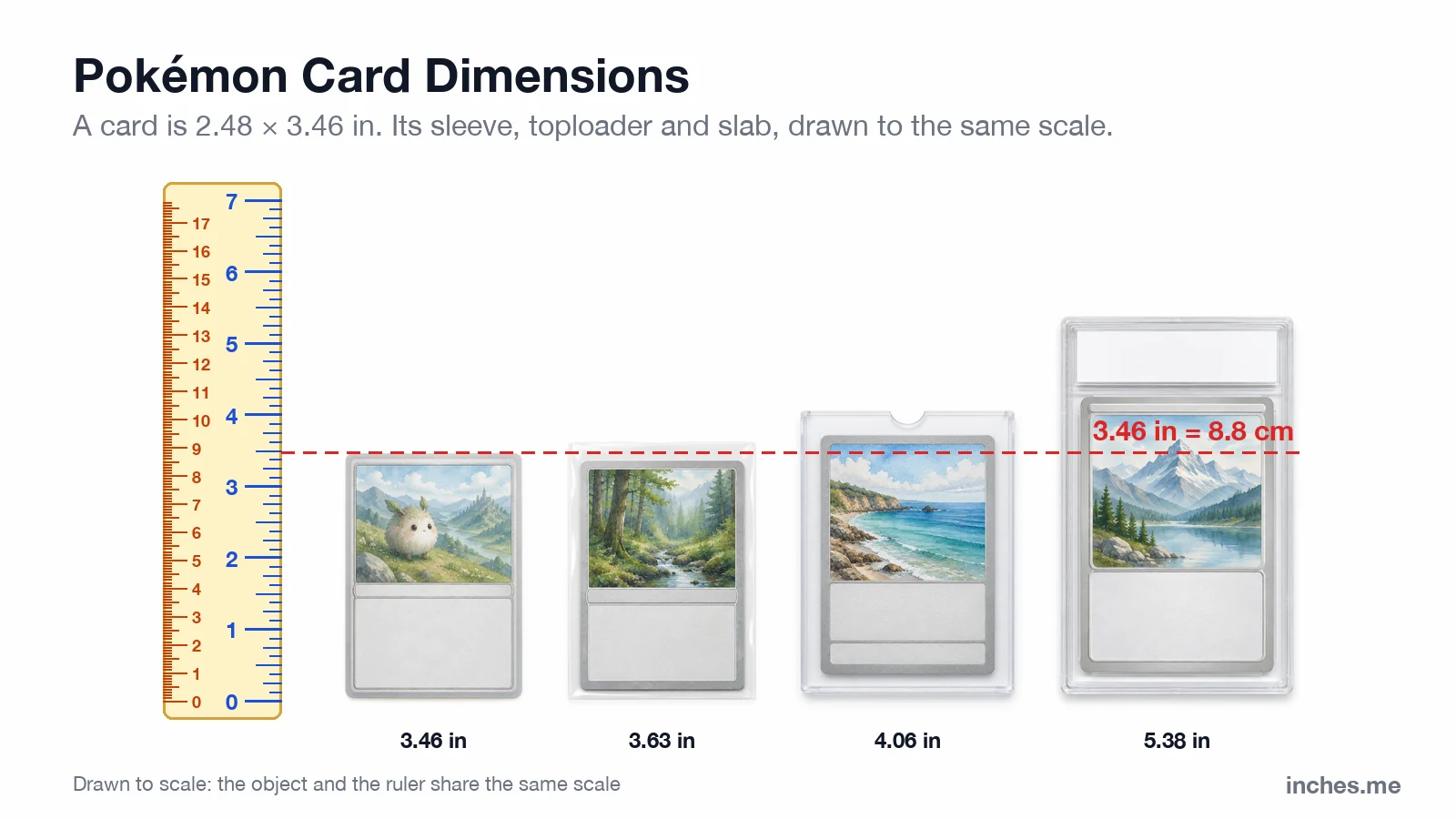
Pokémon card size at a glance
| Measurement | Inches | Millimeters | Centimeters |
|---|---|---|---|
| Width | 2.48 in | 63 mm | 6.3 cm |
| Height | 3.46 in | 88 mm | 8.8 cm |
| Thickness | about 0.012 in | about 0.3 mm | 0.03 cm |
| Corner radius | about ⅛ in | about 3 mm | 0.3 cm |
| Diagonal | 4.26 in | 108.2 mm | 10.8 cm |
| Area | 8.59 sq in | 5,544 mm² | 55.44 cm² |
| Weight | 0.06–0.07 oz | 1.8–2.0 g | — |
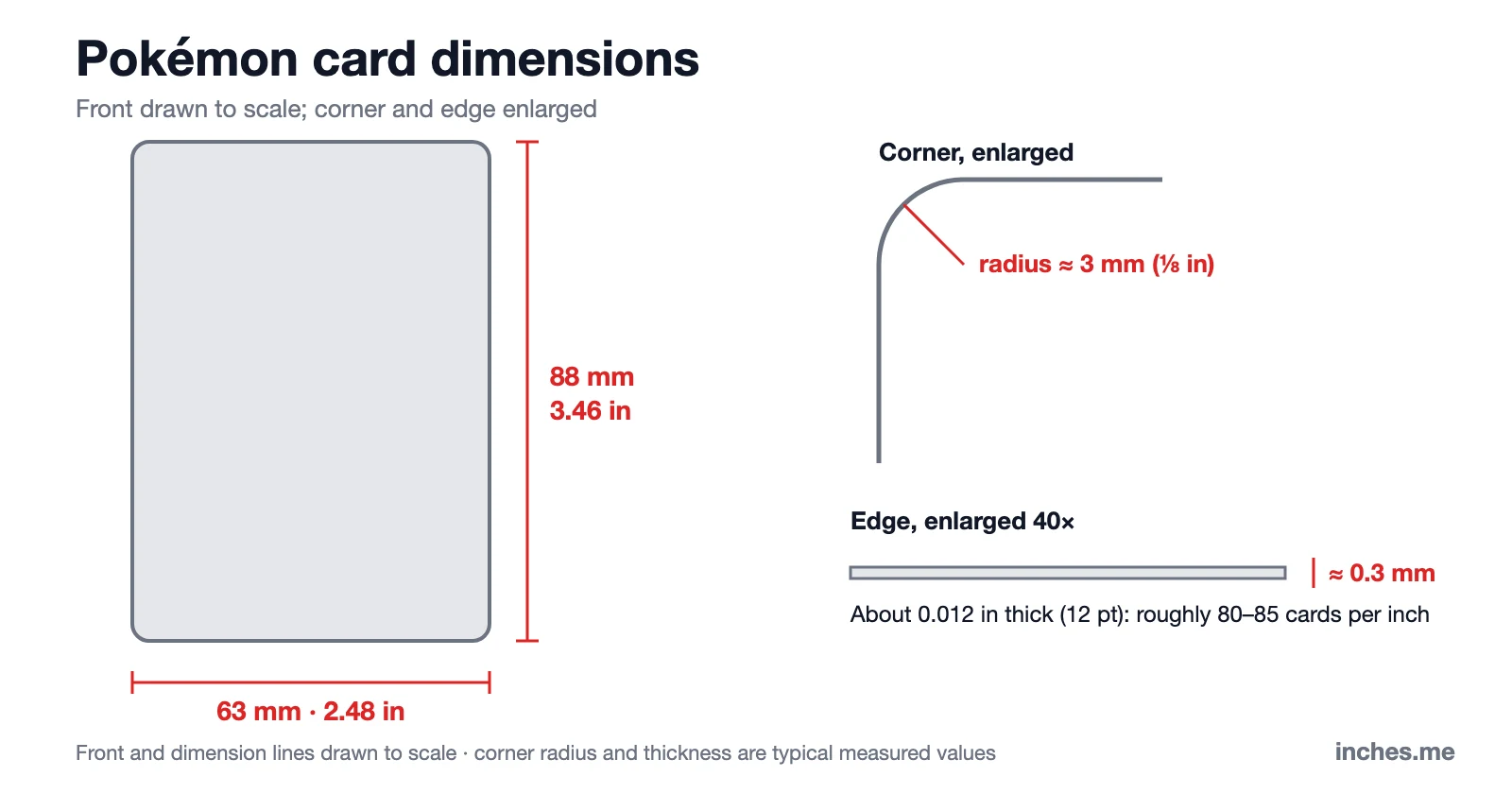
The official size is metric. “2.5 × 3.5 inches” is a rounded figure: an exact 2.5 × 3.5 in card would be 63.5 × 88.9 mm, so a real Pokémon card is about 0.5 mm narrower and 0.9 mm shorter. You will never see the gap by eye, but it explains why some guides print 63.5 × 88.9 mm and others 63 × 88 mm.
The ratio of width to height is about 5 : 7 (0.716), and the corners are rounded with a radius of about 3 mm. There is no official figure for the corners or the thickness: the numbers above are typical measurements.
How big is a Pokémon card in real life?
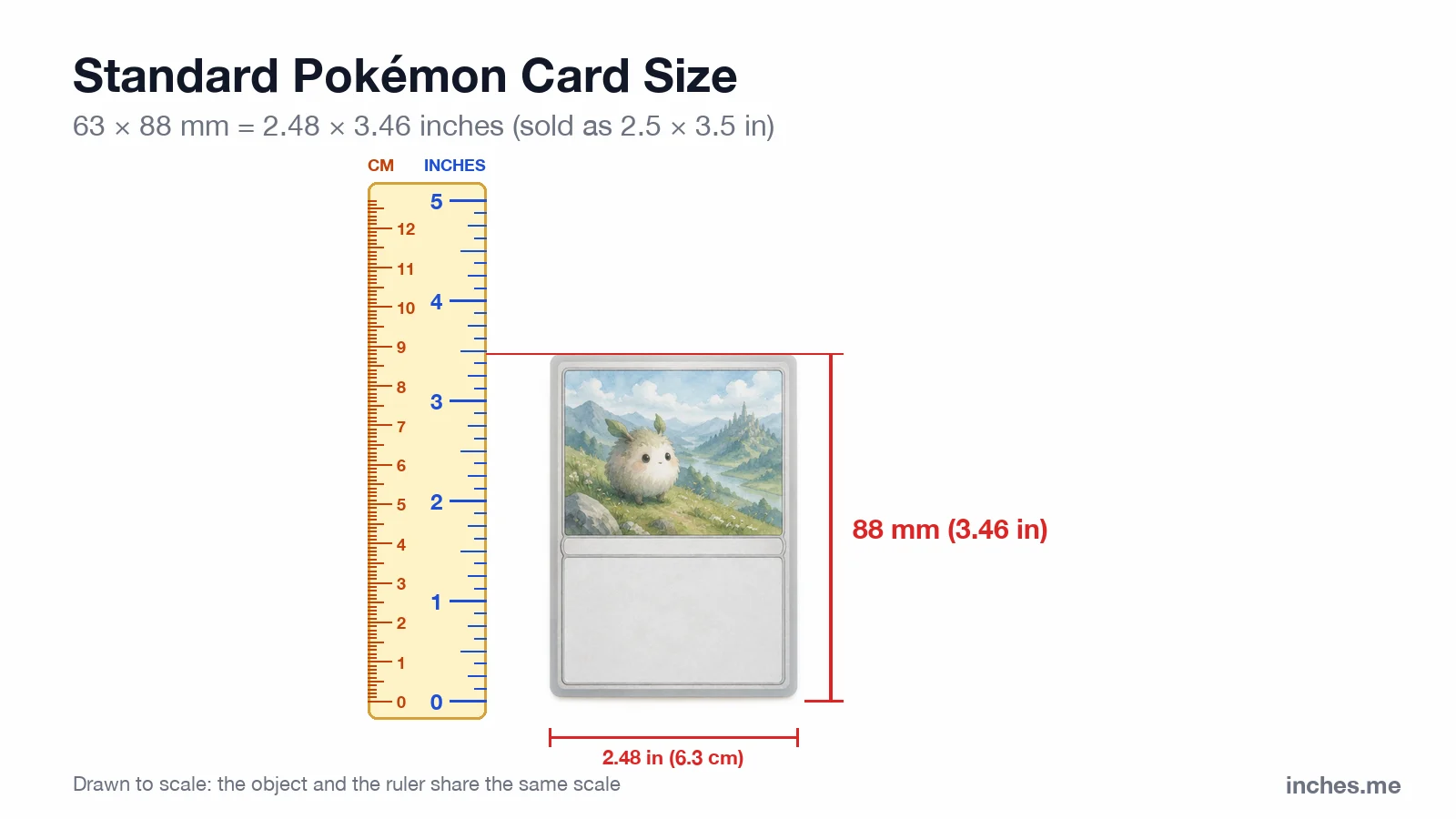
A Pokémon card covers most of an adult’s palm. On a ruler, it reaches just short of the 3½ inch mark (3.46 in) and is just under 2½ inches wide.
- Next to a credit card: the card is taller (3.46 in vs. 3.37 in for the long side of a credit card) and wider (2.48 in vs. 2.125 in). A credit card is held sideways, a Pokémon card upright.
- Next to a dollar bill: a bill is 2.61 in tall, so a Pokémon card is about as wide as a bill is tall.
- Next to a 3 × 5 index card: the Pokémon card is about half an inch narrower and 1.5 inches shorter.
Are Pokémon cards 3.5 inches? Almost: 3.46 inches, which rounds to 3.5. Are they 3 × 4 inches? No. 3 × 4 inches is the size of a toploader, the rigid holder that protects one card (see below).
How thick is a Pokémon card, and how much does it weigh?
Measured cards come out at about 0.30 to 0.33 mm thick, or 0.012 to 0.013 inch. In the “point” unit used for card holders (1 pt = 0.001 in), that is about 12 to 13 pt. Some guides say Pokémon cards are 35 pt: that number is the capacity of a standard toploader, not the thickness of the card.
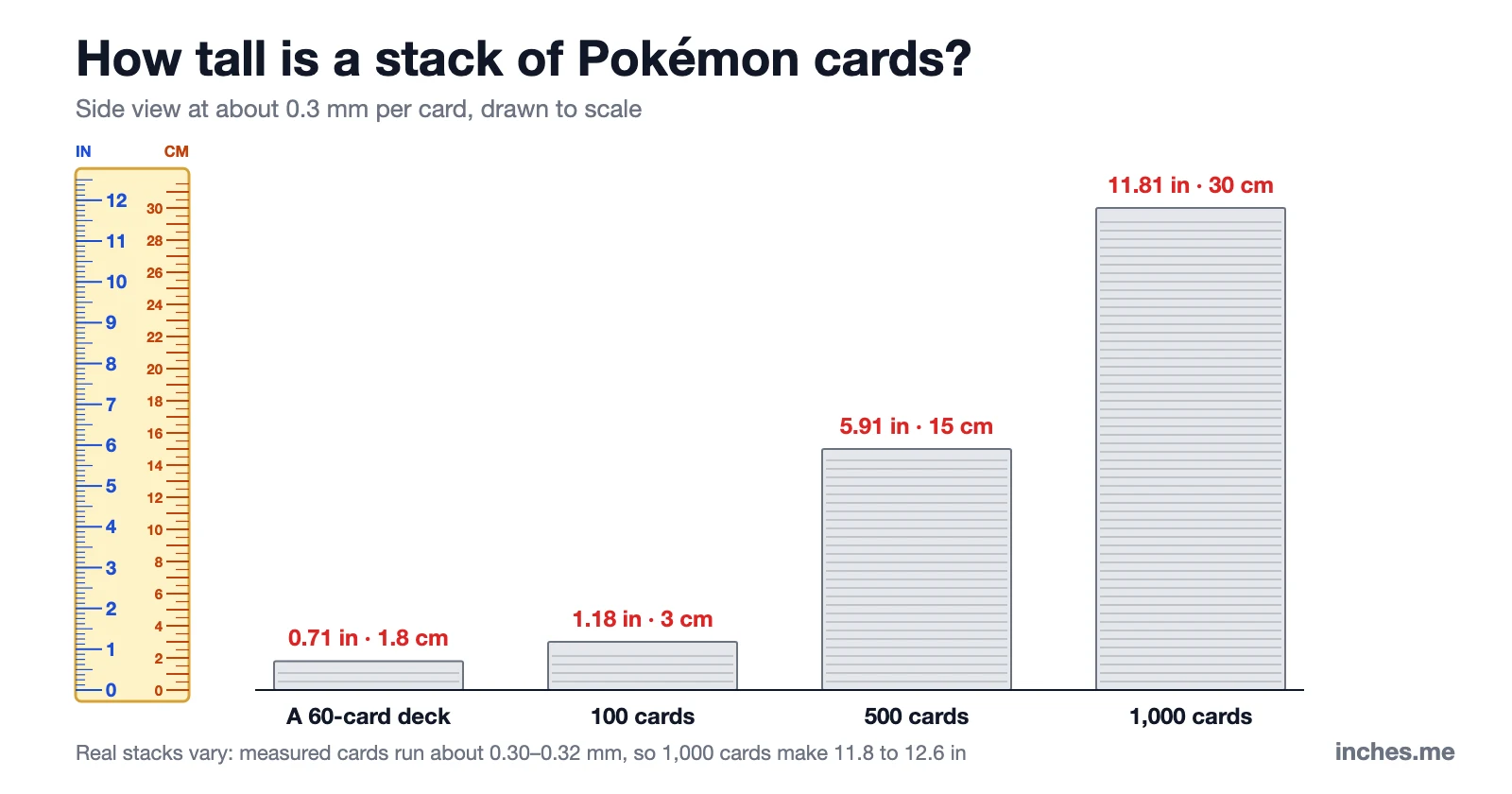
- A 60-card deck stacks to about 0.71 in (1.8 cm) without sleeves.
- One inch of cards holds roughly 80 to 85 cards.
- 1,000 cards stand about a foot high: 11.8 to 12.6 inches, depending on the card stock.
A single card weighs about 1.8 to 2 grams (0.06 to 0.07 oz). Holo and full-art cards are a little heavier, because of the foil and extra coating. That puts 1,000 cards at roughly 1.8 to 2 kg, about 4 pounds. A sealed modern booster pack weighs around 22 to 23 grams (0.8 oz), and the figure varies from one set to the next.
Why do people weigh Pokémon packs?
In the early Wizards of the Coast era, a pack with a holo card could be slightly heavier than one without. Some sellers weighed packs, kept the heavy ones and sold the light ones, which is why buyers of vintage packs still worry about “weighed” packs.
Later sets made that trick unreliable: every pack got a reverse holo or other foil card, and code cards were reportedly printed in different weights to even out the packs. Modern packs from the same set vary by only a fraction of a gram, so a scale no longer tells you what is inside.
Pokémon cards vs. Magic, Yu-Gi-Oh and other cards
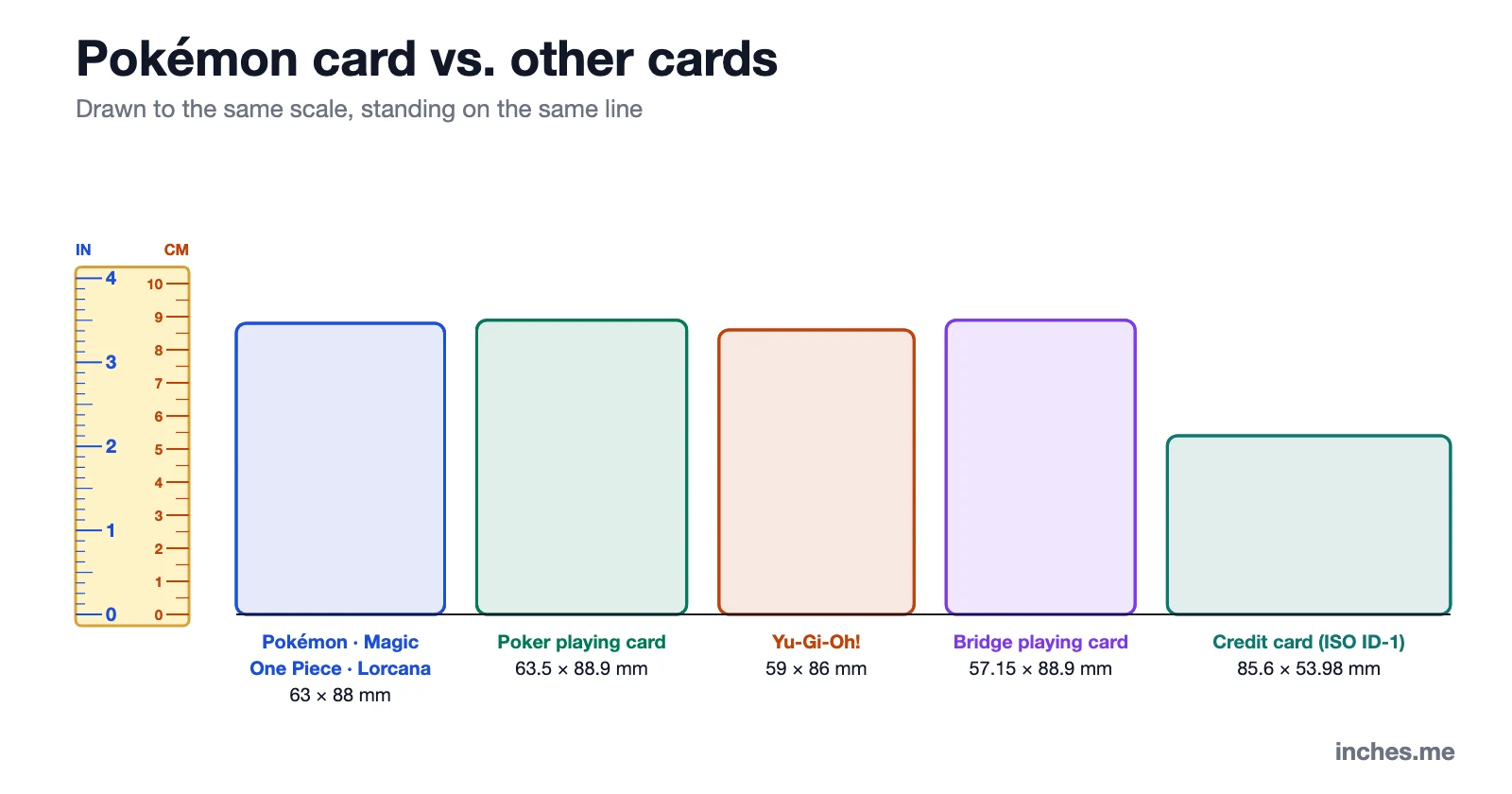
Pokémon uses the “standard” trading card size, shared by most Western card games. Yu-Gi-Oh! is the odd one out, with smaller cards.
| Card | Size (mm) | Size (inches) |
|---|---|---|
| Pokémon | 63 × 88 | 2.48 × 3.46 |
| Magic: The Gathering | 63 × 88 | 2.48 × 3.46 |
| One Piece Card Game | 63 × 88 | 2.48 × 3.46 |
| Disney Lorcana | 63 × 88 | 2.48 × 3.46 |
| Sports cards (baseball, basketball…) | 63.5 × 88.9 | 2.5 × 3.5 |
| Poker-size playing cards | 63.5 × 88.9 | 2.5 × 3.5 |
| Bridge-size playing cards | 57.2 × 88.9 | 2.25 × 3.5 |
| Yu-Gi-Oh! | 59 × 86 | 2.32 × 3.39 |
| Credit card (ISO/IEC 7810 ID-1) | 85.6 × 53.98 | 3.37 × 2.125 |
So yes, Pokémon and Magic cards are the same size, and the same sleeves fit both. A standard sleeve is too loose for a Yu-Gi-Oh! card, and a Yu-Gi-Oh! sleeve is too small for a Pokémon card.
Are Japanese Pokémon cards smaller?
No. Japanese Pokémon cards are the same 63 × 88 mm as English ones, and Pokémon’s own sleeves sold in Japan are standard size. The confusion comes from “Japanese size” sleeves, which are made for Yu-Gi-Oh! and other smaller cards: they will not fit a Pokémon card from any country. Collectors often say Japanese cards feel thinner and smoother, but the length and width are the same.
Sleeves, toploaders and slabs: sizes for Pokémon cards
Each protective layer adds a few millimeters. Here are the common sizes, outside dimensions unless noted.
| Protector | Inches | Millimeters | Use |
|---|---|---|---|
| Penny sleeve | 2⅝ × 3⅝ | 66.7 × 92 | Soft, loose first layer |
| Standard deck sleeve | 2.60 × 3.58 | 66 × 91 | Playing; fits Pokémon and Magic |
| Perfect-fit inner sleeve | 2.52 × 3.50 | about 64 × 89 | Under a deck sleeve (double sleeving) |
| “Japanese size” sleeve | 2.44 × 3.50 | 62 × 89 | Too small: made for Yu-Gi-Oh! (59 × 86 mm) |
| Toploader 3 × 4 (outside) | 3 × 4 1⁄16 | 76.2 × 103.2 | Inside: 2¾ × 3⅞ in, cards up to 35 pt |
| PSA graded slab | about 3¼ × 5⅜ | about 83 × 137 | Sealed by the grading company |
| 9-pocket binder page | 8½ × 11 | 216 × 279 | Nine cards, 3-ring binder |
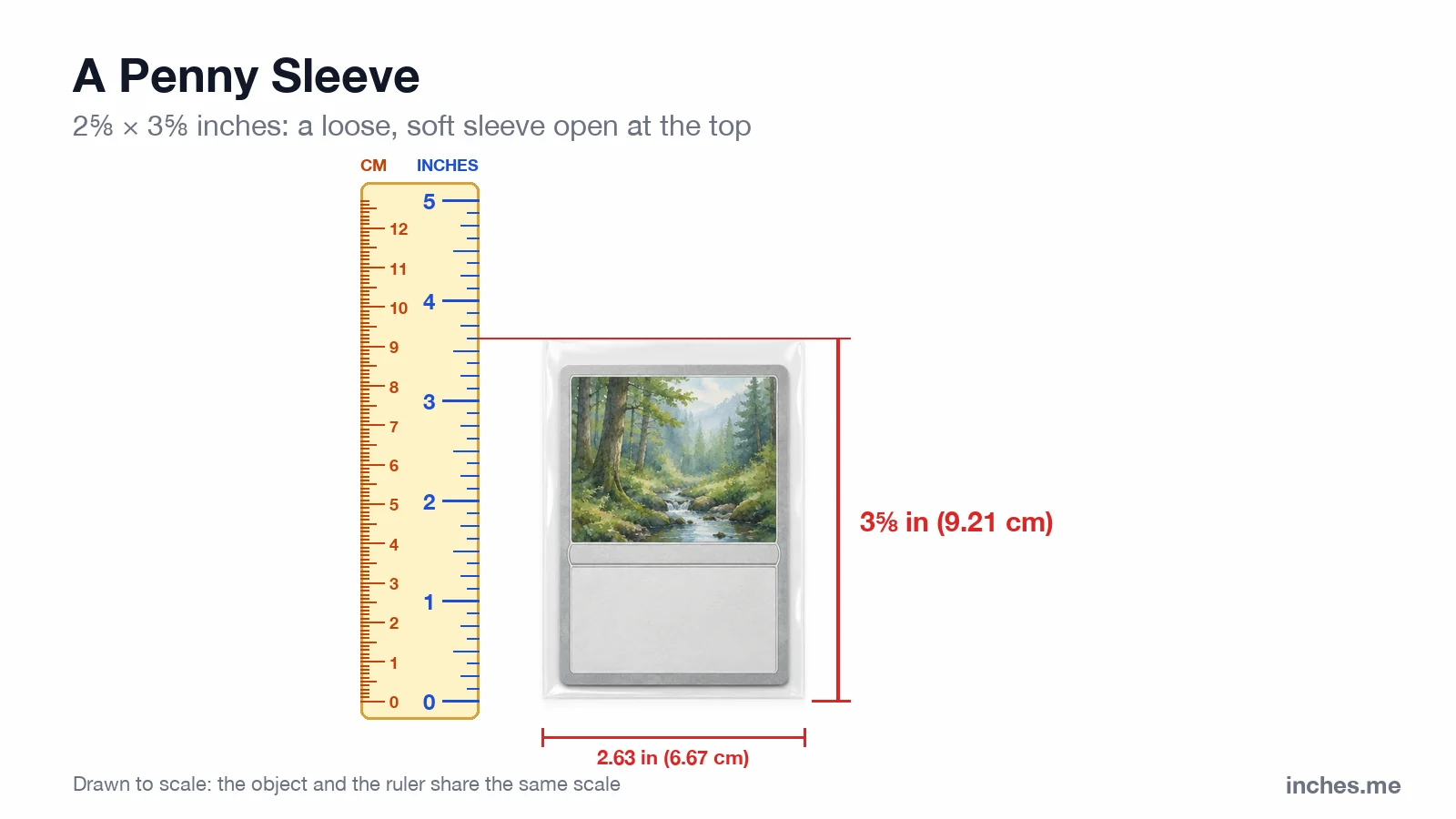
A penny sleeve is the thin, cheap sleeve that goes on a card first. It is about 3.7 mm wider and 4 mm taller than the card, so the card slides in easily.
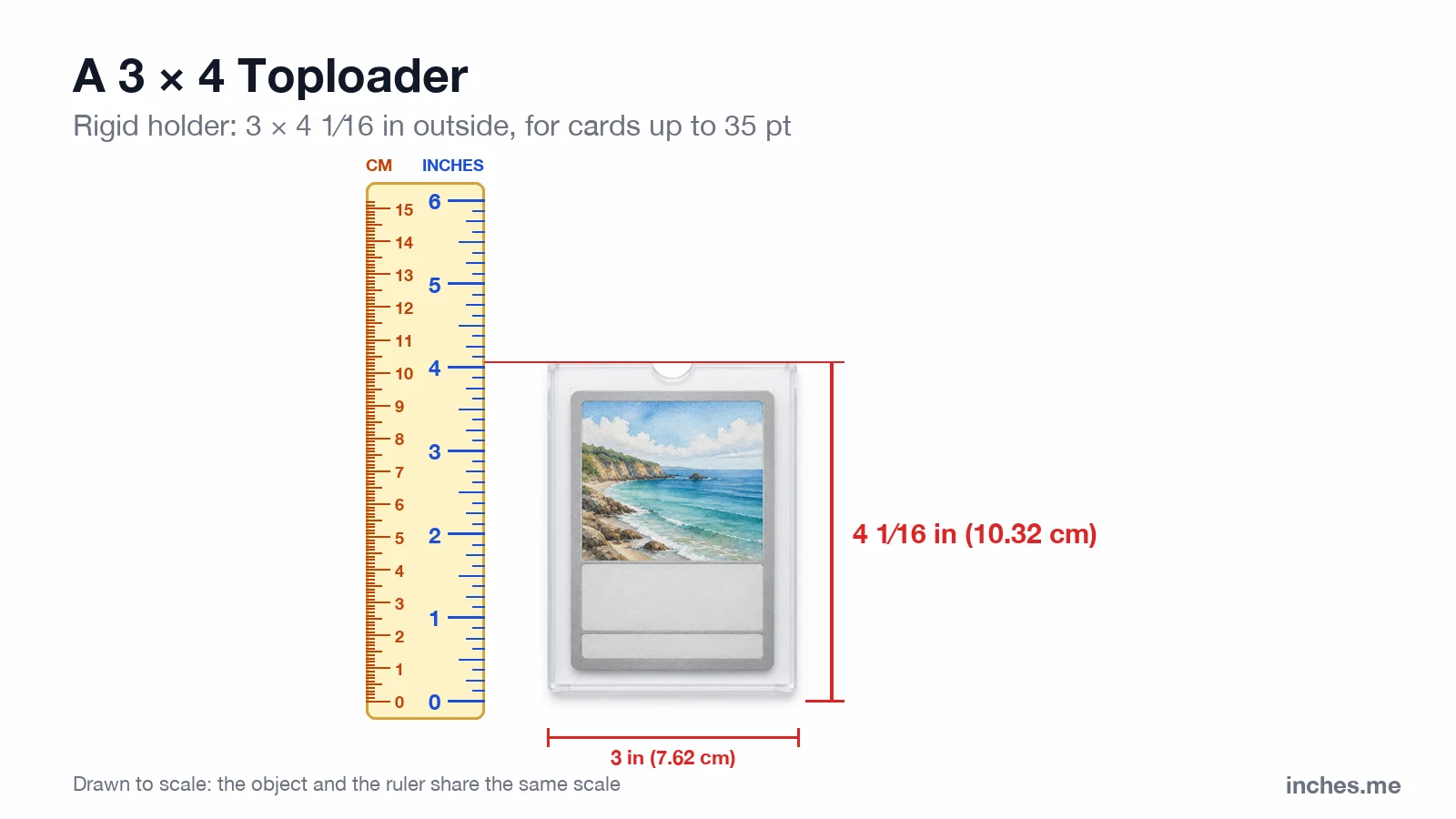
A toploader is a rigid plastic holder, usually called “3 × 4” because it measures 3 × 4 1⁄16 inches outside. The inside pocket is 2¾ × 3⅞ inches, which leaves room for a card in a penny sleeve. The “35 pt” on the package is the thickness of card it holds: 0.035 inch, nearly three times a Pokémon card. Thicker holders (55 pt, 75 pt, 100 pt and up) are for cards with patches or relics.
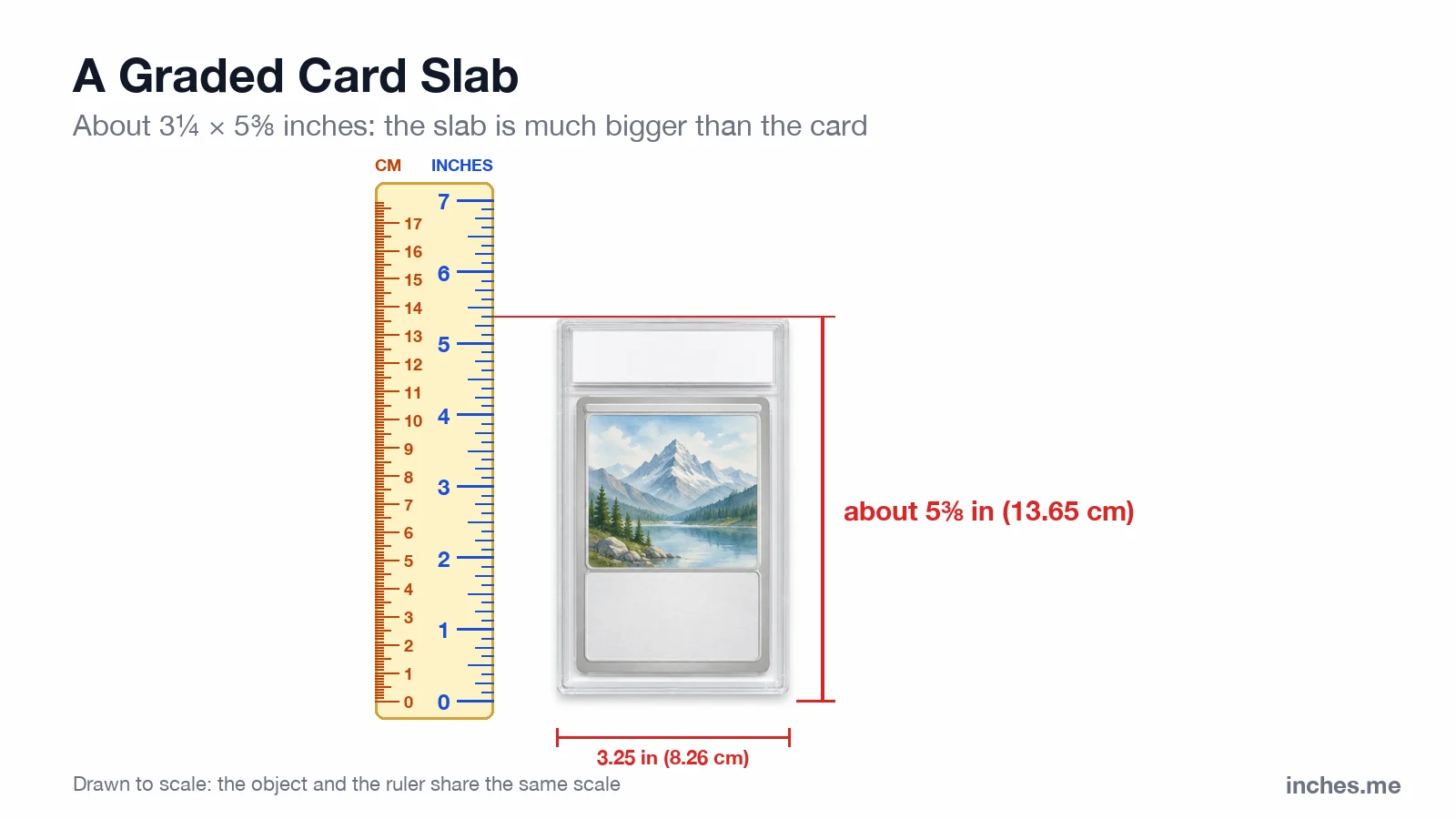
A graded slab is the sealed case a grading company returns. A PSA slab is commonly listed at about 3¼ × 5⅜ inches; CGC and Beckett slabs are within a few millimeters of that. Measure a slab before buying display cases or slab boxes, since even small differences matter for a tight fit.
For binders, the usual page holds nine cards in a 3 × 3 grid and is the size of a US Letter sheet, 8½ × 11 inches, so it fits a standard 3-ring binder.
Jumbo Pokémon card size
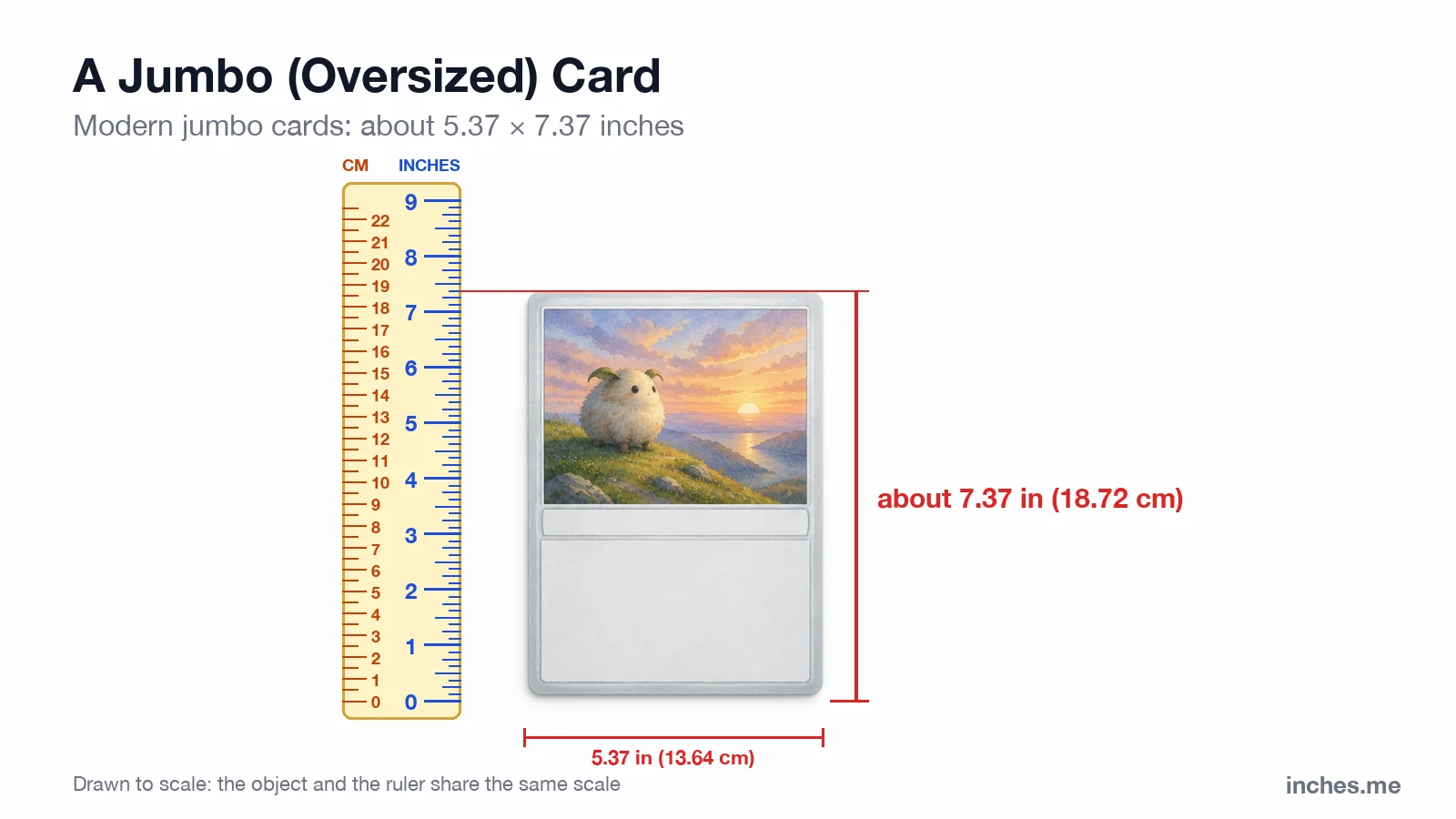
Jumbo (or oversized) cards come in some boxes and collections. Those made since 2020 measure about 5.37 × 7.37 inches (136 × 187 mm): a little more than twice as tall and wide as a standard card, and about 4.6 times its area. Older jumbo cards were a little larger, about 5.7 × 7.9 inches.
Standard sleeves and binders will not hold them. Look for supplies sold as “jumbo” or “oversized”, and check the sizes listed, since jumbo cards have changed over the years.
Printing Pokémon-size cards: pixels, ratio and sheets
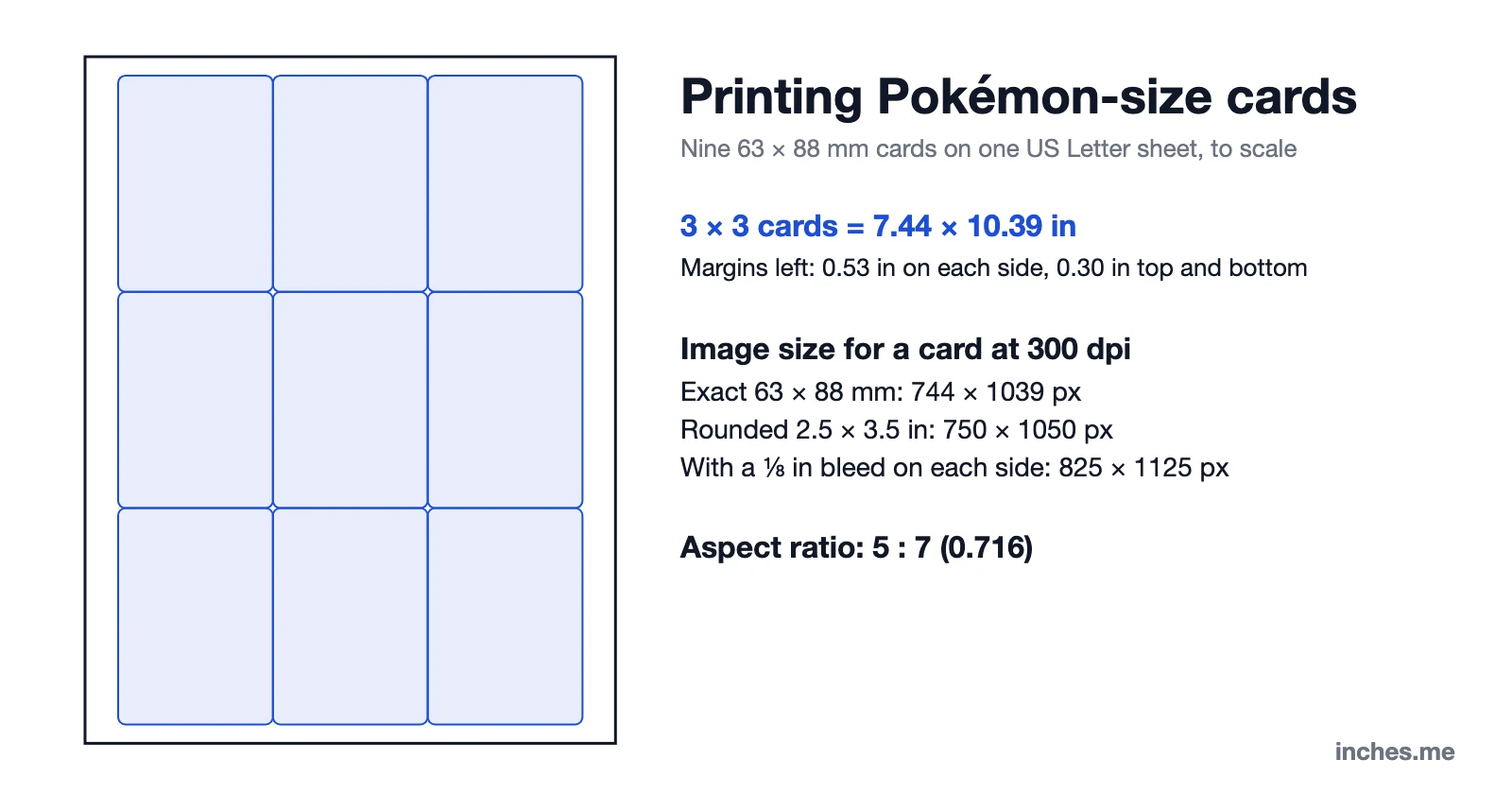
If you design custom cards, game prototypes or trading cards for a party, these are the numbers to set in Canva, Word, Photoshop or Procreate:
- Page size: 63 × 88 mm, or 2.5 × 3.5 inches if your app only takes inches.
- At 300 dpi: 744 × 1039 pixels for the exact size, or 750 × 1050 px for 2.5 × 3.5 in.
- With bleed: add ⅛ inch on each side, which makes 825 × 1125 px at 300 dpi; the printer trims it off.
- On one sheet: nine cards fit on US Letter in a 3 × 3 grid (7.44 × 10.39 in), leaving 0.53 in on each side. They also fit nine to an A4 sheet.
- Corners: a 3 mm (⅛ inch) corner rounder punch gives the same rounded corners as a real card.
The rule behind these numbers works for any image: inches = pixels ÷ dpi. Our Instagram post size in inches guide applies it to every post format.
How many cards are in a Pokémon deck?
A Pokémon TCG deck must have exactly 60 cards, with no more than 4 copies of any card with the same name, except basic Energy cards. Unsleeved, a 60-card deck is about 0.71 inch thick; sleeves make it noticeably thicker, so choose a deck box rated for sleeved cards.
More sizes to compare
- What 5 inches looks like: 12.7 cm, from a 5-inch inseam to a 40d nail
- What 6 inches looks like: 15.24 cm, from a 6-inch sub to 6 inches of snow
- 20 cm in inches: 7.87 in, just under 8 inches
- Inches to cm converter: any length in inches, with a 1–100 inch chart and fractions
- Instagram post size in inches: every format at 72, 150 and 300 dpi
FAQs
A Pokémon card is 63 × 88 mm, or 2.48 × 3.46 inches (6.3 × 8.8 cm), often rounded to 2.5 × 3.5 inches.
Yes, as a rounded size. The exact size is 2.48 × 3.46 inches (63 × 88 mm).
No. 3 × 4 inches is the size of a toploader, the rigid holder that protects one card. The card itself is about 2.5 × 3.5 inches.
Yes. Both are 63 × 88 mm, so the same sleeves, binders and toploaders fit both.
No. Japanese Pokémon cards are the same 63 × 88 mm size. “Japanese size” sleeves are for smaller cards such as Yu-Gi-Oh! and do not fit Pokémon cards.
About 0.3 mm (0.012 inch), or 12 to 13 pt. Roughly 80 to 85 cards make a one-inch stack.
About 1.8 to 2 grams (0.06 to 0.07 oz). 1,000 cards weigh around 4 pounds.
Standard-size sleeves, about 66 × 91 mm, or penny sleeves of 2⅝ × 3⅝ inches. Avoid sleeves labeled “Japanese size”.
Need to convert another measurement? Use the cm to inches converter or the inches to cm converter.