

Published
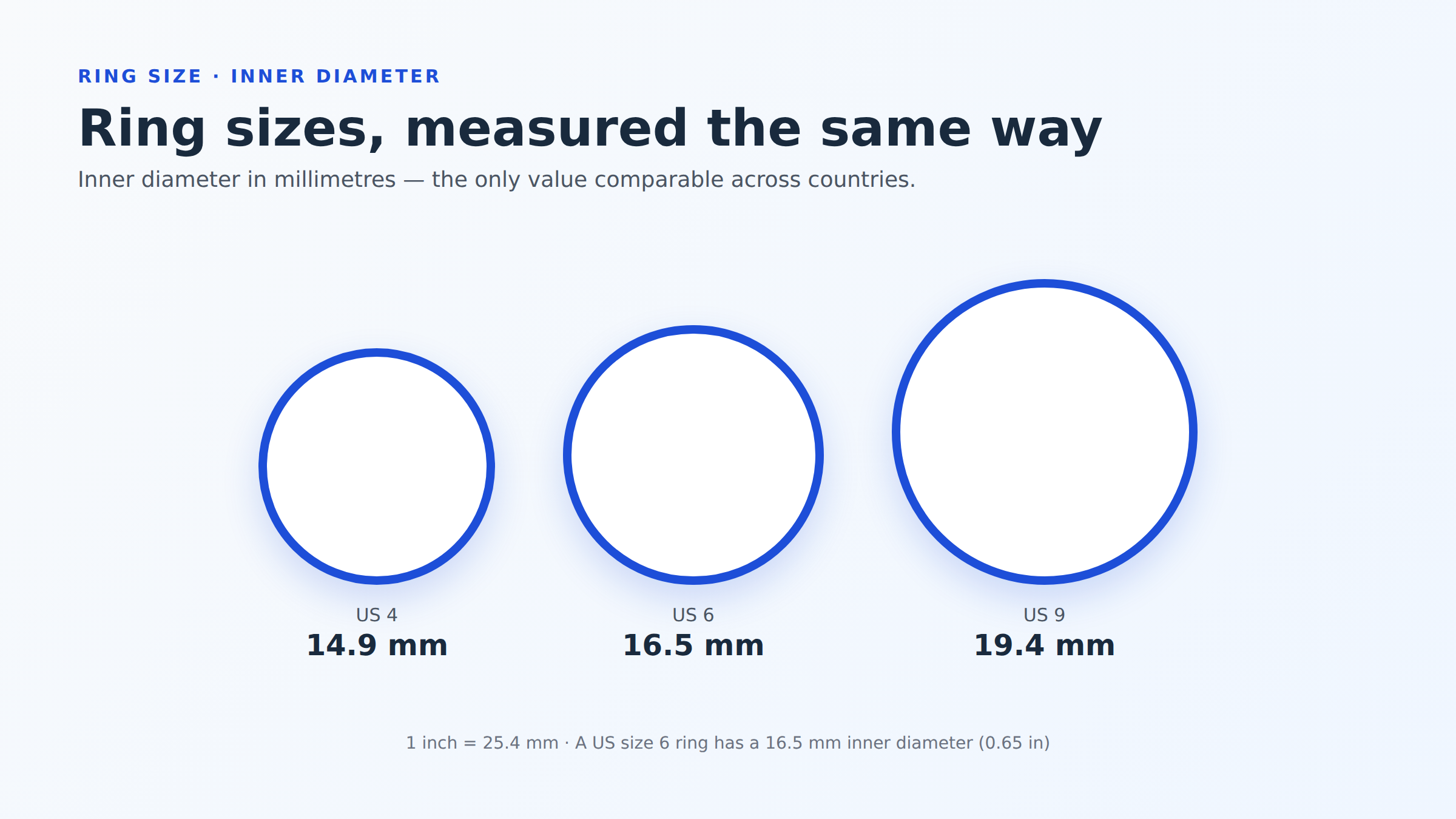
A US size 7 ring has an inside diameter of 0.681 inch (17.30 mm). The whole US scale is built on a single rule: every full size adds 2.55 mm of inside circumference, which works out at 0.812 mm of diameter — about 0.032 inch. The chart below lists every US size from 1 to 15, half sizes included, with the inside diameter and circumference in inches and millimetres and the matching UK, EU and Japanese sizes.
Ring size is always an inside measurement. The outside of a band is wider than the size it carries, by twice the thickness of the metal, so a ring measured across the outside will always read too large.
Ring size chart in inches and mm (US, UK, EU, JP)
| US size | Inside diameter (in) | Inside diameter (mm) | Inside circumference (in) | Inside circumference (mm) | UK | EU / ISO | JP |
|---|---|---|---|---|---|---|---|
| 1 | 0.489 in | 12.43 mm | 1.537 in | 39.05 mm | B½ | 39 | — |
| 1.5 | 0.505 in | 12.84 mm | 1.588 in | 40.33 mm | C½ | 40 | 1 |
| 2 | 0.521 in | 13.24 mm | 1.638 in | 41.60 mm | D½ | 42 | 2 |
| 2.5 | 0.537 in | 13.65 mm | 1.688 in | 42.88 mm | E½ | 43 | 3 |
| 3 | 0.553 in | 14.05 mm | 1.738 in | 44.15 mm | F½ | 44 | 4 |
| 3.5 | 0.569 in | 14.46 mm | 1.788 in | 45.42 mm | G½ | 45 | 6 |
| 4 | 0.585 in | 14.87 mm | 1.839 in | 46.70 mm | H½ | 47 | 7 |
| 4.5 | 0.601 in | 15.27 mm | 1.889 in | 47.98 mm | I½ | 48 | 8 |
| 5 | 0.617 in | 15.68 mm | 1.939 in | 49.25 mm | J½ | 49 | 9 |
| 5.5 | 0.633 in | 16.08 mm | 1.989 in | 50.52 mm | K½ | 51 | 11 |
| 6 | 0.649 in | 16.49 mm | 2.039 in | 51.80 mm | L½ | 52 | 12 |
| 6.5 | 0.665 in | 16.89 mm | 2.090 in | 53.08 mm | M½ | 53 | 13 |
| 7 | 0.681 in | 17.30 mm | 2.140 in | 54.35 mm | N½ | 54 | 15 |
| 7.5 | 0.697 in | 17.71 mm | 2.190 in | 55.62 mm | O½ | 56 | 16 |
| 8 | 0.713 in | 18.11 mm | 2.240 in | 56.90 mm | P½ | 57 | 17 |
| 8.5 | 0.729 in | 18.52 mm | 2.290 in | 58.17 mm | Q½ | 58 | 18 |
| 9 | 0.745 in | 18.92 mm | 2.341 in | 59.45 mm | R½ | 59 | 20 |
| 9.5 | 0.761 in | 19.33 mm | 2.391 in | 60.72 mm | S½ | 61 | 21 |
| 10 | 0.777 in | 19.74 mm | 2.441 in | 62.00 mm | T½ | 62 | 22 |
| 10.5 | 0.793 in | 20.14 mm | 2.491 in | 63.27 mm | U½ | 63 | 23 |
| 11 | 0.809 in | 20.55 mm | 2.541 in | 64.55 mm | V½ | 65 | 25 |
| 11.5 | 0.825 in | 20.95 mm | 2.592 in | 65.83 mm | W½ | 66 | 26 |
| 12 | 0.841 in | 21.36 mm | 2.642 in | 67.10 mm | X½ | 67 | 27 |
| 12.5 | 0.857 in | 21.76 mm | 2.692 in | 68.38 mm | Y½ | 68 | — |
| 13 | 0.873 in | 22.17 mm | 2.742 in | 69.65 mm | Z½ | 70 | — |
| 13.5 | 0.889 in | 22.58 mm | 2.792 in | 70.92 mm | Z+1 | 71 | — |
| 14 | 0.905 in | 22.98 mm | 2.843 in | 72.20 mm | Z+2 | 72 | — |
| 14.5 | 0.921 in | 23.39 mm | 2.893 in | 73.47 mm | Z+3 | 73 | — |
| 15 | 0.937 in | 23.79 mm | 2.943 in | 74.75 mm | Z+4 | 75 | — |
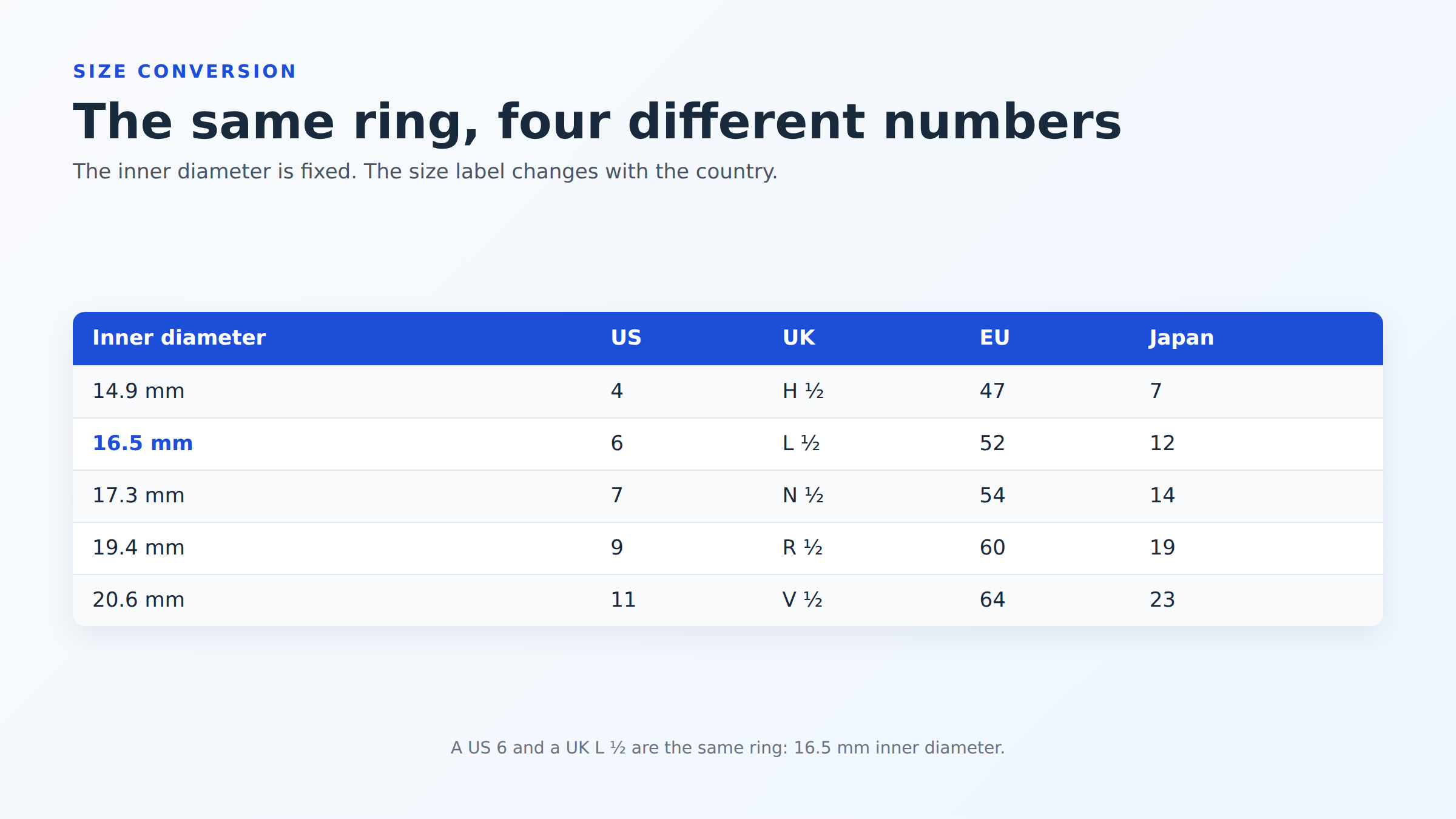
Inside diameter is the column to trust. The UK letter, the EU number and the Japanese number are all derived from the same physical measurement, and the three national scales do not step in the same increments, so some rows round in different directions.
How the US ring size scale is built
The US scale is linear in circumference, not in diameter. Size 0 corresponds to an inside circumference of 36.5 mm, and each whole size adds 2.55 mm:
- Inside circumference (mm) = 36.5 + 2.55 × size
- Inside diameter (mm) = circumference ÷ 3.1416
- Inside diameter (in) = diameter in mm ÷ 25.4
One full US size is therefore 2.55 mm of circumference and 0.812 mm of diameter, or 0.032 inch. A half size is 1.275 mm of circumference and 0.406 mm of diameter — 0.016 inch. That is the figure that explains why half sizes exist at all: the difference between a size 7 and a size 7½ is sixteen thousandths of an inch across the finger, and it is easily felt.
It also explains why a ruler marked in sixteenths of an inch is the wrong tool. One sixteenth of an inch is 1.5875 mm, which spans almost two whole US sizes. Read the millimetre edge instead.
What the UK, EU and JP columns mean
UK letter sizes
The UK scale uses letters, and the step is half the US step: one UK letter equals half a US size. US 6 is UK L½, US 6½ is M½, US 7 is N½, and so on up the alphabet. Below Z the mapping is regular and the whole chart can be read off that one rule.
Above Z the notation is not standardised. The same physical ring is written Z½, Z+1 or Z1 depending on the maker, and the counting sometimes restarts. For anything above about US 12½, quote the inside diameter in millimetres rather than the letter.
EU and ISO sizes
The European scale defined by ISO 8653 is the easiest of the three to read: the size number is the inside circumference in millimetres. A ring of 54 mm inside circumference is an EU 54, which is a US 7 (54.35 mm). Because US sizes land on fractional millimetres, the EU column rounds, and two neighbouring US half sizes can round to EU numbers that are one or two apart.
A separate French convention subtracts 40 from the circumference, so the same ring is written 14 instead of 54. If a number looks forty units too small, that is why.
Japanese sizes
Japanese sizes (号) run from 1 to 27. Size 1 is an inside circumference of 40.8 mm, and each step adds about 1 mm of circumference — roughly 0.32 mm of diameter. A US half size is 1.275 mm of circumference, so the two scales do not line up: moving up one US half size sometimes skips a Japanese number. The Japanese scale also runs out above US 12, which is why the last rows of the chart are blank.
How to measure a ring size with a ruler or a strip of paper
Method 1 — measure a ring that already fits
- Lay the ring flat on a table, with the band touching the surface all the way round.
- Put the millimetre edge of a ruler across the opening and read the inside distance at the widest point, from the inner edge of the metal to the inner edge opposite.
- Read to the nearest half millimetre. Half a millimetre is about six tenths of a US size, so this is the step that decides the result.
- Find that figure in the inside diameter column of the chart.
This is the most reliable home method, because it measures a finished object rather than a soft finger. Its weak point is reading the inner edge: looking at the ring from an angle makes the opening appear smaller and pushes the result down by a size or more. Look straight down on it.
Method 2 — measure the finger with paper
- Cut a straight strip of paper about 5 mm wide. A wide strip bridges the dip between knuckle and base and reads too large.
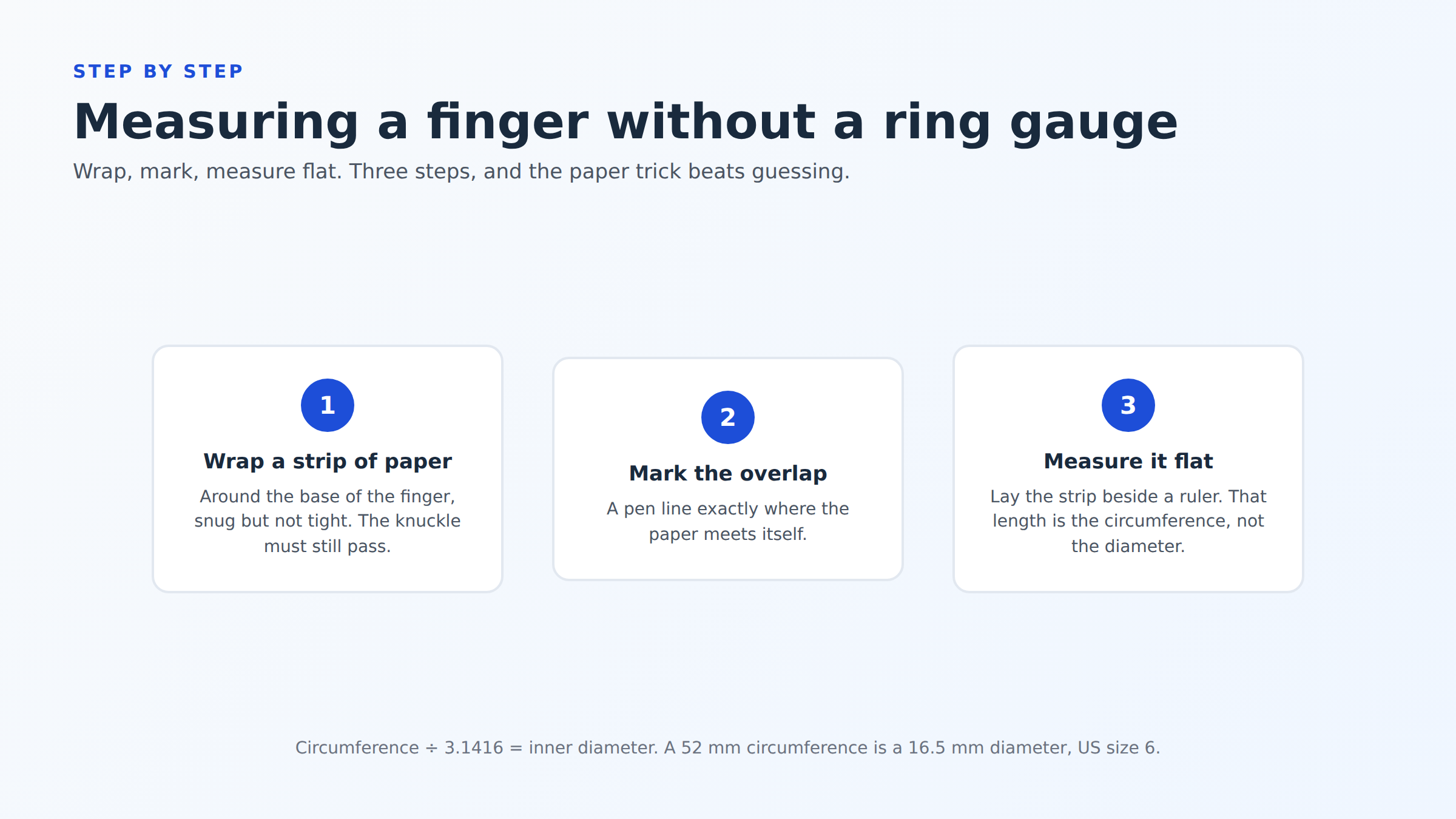
- Wrap it around the base of the finger, snug enough that it will not slide off but loose enough to turn.
- Mark the point where the strip overlaps itself, with the pen held against the edge of the overlapping end.
- Lay the strip flat and measure from the end to the mark in millimetres. That length is the inside circumference.
- Check that the strip also passes over the knuckle at that length. If it does not, the ring has to be sized to the knuckle.
- Find the circumference in the chart.
Use paper, not string or thread. String stretches and bites into the skin; pulled tight it reads 1 to 2 mm short, and 2 mm of circumference is most of a whole US size.
When to measure
- Late in the day, at normal room temperature. Fingers are smallest on a cold morning and largest after heat, exercise or a salty meal. The normal daily swing is around half a size.
- Three times, on different days. Take the largest reading, not the average: a ring that cannot go on is useless, a slightly loose one can be padded.
- On the hand it will be worn on. The dominant hand usually measures a little larger than the other.
Why two rings in the same size can fit differently
Ring size describes one number — the inside circumference — and a finger is not a cylinder. Three features of the ring itself change how that number feels.
Band width
A wide band covers more of a tapered, compressible finger, so it has to be larger to feel the same. This is the single biggest source of a size that measured correctly and still does not fit.
| Band width | Adjustment from a measured size | Why |
|---|---|---|
| 1–3 mm (0.04–0.12 in) | No change | Narrow bands sit in the hollow of the finger and read the same as a sizing gauge. |
| 4 mm (0.16 in) | No change, or +¼ | The usual reference width. Most size charts assume a band near this width. |
| 5–6 mm (0.20–0.24 in) | +¼ to +½ size | The band starts to bridge the taper of the finger instead of following it. |
| 7–8 mm (0.28–0.31 in) | +½ size | More skin is trapped under the metal and the ring stops rotating freely. |
| 9 mm and wider (0.35 in+) | +½ to +1 size | A wide band behaves like a short tube; it has to clear the knuckle along its whole length. |
Inside profile
A flat inside wall sits square against the skin. A comfort-fit band has a domed inner surface, so only the middle of the band touches: it slides over the knuckle more easily and feels about a quarter to a half size looser. The same finger often takes a half size down in comfort fit.
Knuckle versus base
The ring has to pass the knuckle and then sit at the base. When the knuckle measures more than about one full size larger than the base, no single size does both jobs: a ring that clears the knuckle will spin at the base.
Metal thickness
Thickness changes the outside, never the size. A band 2 mm thick measures 4 mm more across the outside than the inside — on a US 7, that is 21.30 mm outside against 17.30 mm inside, a difference of nearly ten US sizes if the wrong face is measured.
Common inch fractions as ring sizes
Inside diameters are often quoted as inch fractions. These are the equivalents on the US scale:
| Inside diameter (fraction) | Decimal inches | Millimetres | Nearest US size |
|---|---|---|---|
| 1/2 in | 0.5000 in | 12.70 mm | US 1.3 |
| 9/16 in | 0.5625 in | 14.29 mm | US 3.3 |
| 5/8 in | 0.6250 in | 15.88 mm | US 5.2 |
| 11/16 in | 0.6875 in | 17.46 mm | US 7.2 |
| 3/4 in | 0.7500 in | 19.05 mm | US 9.2 |
| 13/16 in | 0.8125 in | 20.64 mm | US 11.1 |
| 7/8 in | 0.8750 in | 22.22 mm | US 13.1 |
| 15/16 in | 0.9375 in | 23.81 mm | US 15.0 |
Each sixteenth of an inch of diameter covers nearly two US sizes, so a fraction is never a precise ring size. Use it to find the right part of the chart, then measure in millimetres.
Quick answers from the chart
- US 6 — 0.649 in / 16.49 mm inside diameter, UK L½, EU 52.
- US 7 — 0.681 in / 17.30 mm, UK N½, EU 54.
- US 9 — 0.745 in / 18.92 mm, UK R½, EU 59.
- US 10 — 0.777 in / 19.74 mm, UK T½, EU 62.
- US 12 — 0.841 in / 21.36 mm, UK X½, EU 67.
More measurements to compare
- Shoe size chart in inches: US, UK and EU sizes against foot length in inches and cm
- Paper size chart in inches and mm: A0 to A6, Letter, Legal and Tabloid
- Which is bigger, 5/8 or 3/4 inch?: the full inch fraction chart in decimals and mm
- Inches to cm converter: any length in inches, with a 1–100 inch chart and fractions
- Cm to inches converter: the same conversion the other way
FAQs
A US size 7 ring has an inside diameter of 0.681 inch (17.30 mm) and an inside circumference of 2.140 inches (54.35 mm).
Lay a ring that already fits flat on a table and measure the inside, edge to edge, across the widest point, using the millimetre edge of the ruler. Match that diameter to the chart. To measure the finger instead, wrap a 5 mm wide strip of paper around the base of the finger, mark the overlap, lay the strip flat and read the length in millimetres: that is the inside circumference.
Both describe the same ring. The US scale is defined on inside circumference (36.5 mm plus 2.55 mm per size), while most ruler measurements are taken as inside diameter. Diameter multiplied by 3.1416 gives the circumference.
US 7 is UK N½ and EU 54. The EU number is simply the inside circumference in whole millimetres, which for US 7 is 54.35 mm.
Yes, above about 5 mm of width. A 6 mm band usually needs a quarter to a half size more than a 2 mm band on the same finger, and a 9 mm band can need a full size more.
Finger volume changes through the day with temperature, activity and salt intake. The normal swing is around half a US size, which is about 0.4 mm of inside diameter (0.016 inch). Fingers are usually smallest on a cold morning and largest late in the day.
Need to convert another measurement? Use the inches to cm converter or the cm to inches converter.